

When you care about someone and do not know whether they want the same relationship, waiting can become a difficult part of everyday life. You may be hoping for a change while wondering how much time, attention and emotional energy to give the situation.
Reciprocal love means that affection and interest go both ways. You cannot make another person feel or promise it. You can ask what they want, decide whether the arrangement works for you and keep your own needs in view while you consider your next step.
On this page
1. Name what you want
Start with the relationship you would like to participate in. You may want to date, become exclusive, make long-term plans or understand whether a friendship could become romantic. These are different questions, and a broad hope that “things will work out” may leave the important details unspoken.
Consider what would make the relationship workable for you now. For example: “I would like us to date openly and make plans together,” or “I am looking for an exclusive relationship, rather than an occasional intimate connection.” You do not need to apologise for a preference, and the other person gets to decide whether they want it too.
Your needs can include privacy, time with friends, a pace you are comfortable with and freedom from pressure. New York State’s healthy-relationship guide emphasises mutual respect, independence and decisions made without fear of retaliation.
2. Ask about the present
Where it feels safe to talk, ask a clear question about what is available now. “Would you like to date me?” is easier to understand than trying to interpret a warm message or waiting for the right sign. If you are already dating, ask what each of you means by commitment.
You might say, “I enjoy being with you, and I want an exclusive relationship. Is that something you want with me?” Give the person room to answer. You can ask for clarification without turning the conversation into an argument about why they should feel differently.
Take a no seriously. If the answer is uncertainty or “I am not ready,” you do not have to prove whether that means no forever or discover a hidden motive. It tells you that a clear yes is not available now. Our article What Do I Do When My Partner Isn’t Ready? explores ways to consider differing timelines and needs.
3. Separate feelings and availability
Someone may care about you and still be unable or unwilling to participate in the relationship you want. Thoughtful conversations, affection and shared memories can matter without serving as promises of future commitment.
Look at the current arrangement: what has been agreed, whether plans are followed through and whether both people can express concerns. Avoid treating a single gesture as proof of love or a delay as proof of manipulation. You do not need certainty about someone’s inner feelings before deciding that an arrangement does not suit you.
Ask yourself, “If nothing changed for a while, would I freely choose this?” The answer can help you distinguish enjoying what exists from staying mainly because you hope it will become something else. Either way, you can take time to think.
4. Make agreements clear
If you both want to continue seeing each other while taking things slowly, discuss what that means. Consider contact, dates, exclusivity, physical intimacy and how you will let each other know if your wishes change. Do not assume that waiting automatically creates an agreement.
- Contact: What amount of communication feels comfortable to each of you?
- Exclusivity: Have you explicitly agreed to date only each other, or is that still undecided?
- Intimacy: What are you each comfortable with now? Consent to one activity is not an obligation to continue it.
- Changes: How will you raise a concern or say that you no longer want the arrangement?
If you have an exclusivity agreement, discuss changing it before dating other people. If there is no agreement, clarify expectations instead of using other dates to provoke jealousy or test someone’s feelings. You can also decide not to date anyone while you think; there is no requirement to keep searching.

5. Choose a review point
There is no timetable that guarantees mutual love. Rather than choosing a deadline by which the other person must change, decide when you will review your own participation. Consider your circumstances and what waiting is costing you in attention, plans and emotional energy.
At that point, ask what has actually changed. Have your questions been answered? Does the arrangement still fit your needs? Are you continuing because you choose the present relationship, or because it feels difficult to leave a long-standing hope behind?
You can share a limit respectfully: “I do not want to keep dating without a shared intention. If we want different things, I will step back.” A boundary describes what you will do. It does not require the other person to promise affection, and you do not have to extend it repeatedly to demonstrate patience.
6. Clarify existing relationships and breaks
If the person is in another relationship, focus on what is actually available rather than assuming they will leave or judging that relationship from the outside. You can choose not to participate in a secret or uncertain arrangement. You do not need to monitor another couple’s private life to justify that choice.
A relationship “break” does not have one universal meaning. Ask what agreements are in place rather than assuming it means freedom to date, a certain reunion or an inevitable breakup. If the situation remains unclear, you can decide that you do not want to become more involved.
A recent breakup also does not tell you exactly when someone will be ready for another relationship. Avoid competing with an ex or making yourself responsible for someone else’s recovery. Listen to what the person says they can offer and decide whether it fits what you want.
7. Make your next choice
You may choose to continue an arrangement with clearer agreements, take some time apart or end romantic contact. Step back without turning it into a tactic to make the other person pursue you. If a friendship is possible, it still needs to be something both of you want, with limits you can comfortably keep.
Keep room for friends, interests, rest and plans that matter to you. If the situation is occupying most of your attention or making daily life difficult, talk it through with someone you trust or a counsellor. You do not have to settle the whole future in one conversation.
If you fear threats, coercion or retaliation, seek individual support from a domestic-abuse service rather than confronting the person to prove a boundary. In an ordinary uncertain situation, one useful next step may be a clear question, a practical limit or an honest acknowledgement that you want different things.
Read the infographic in text
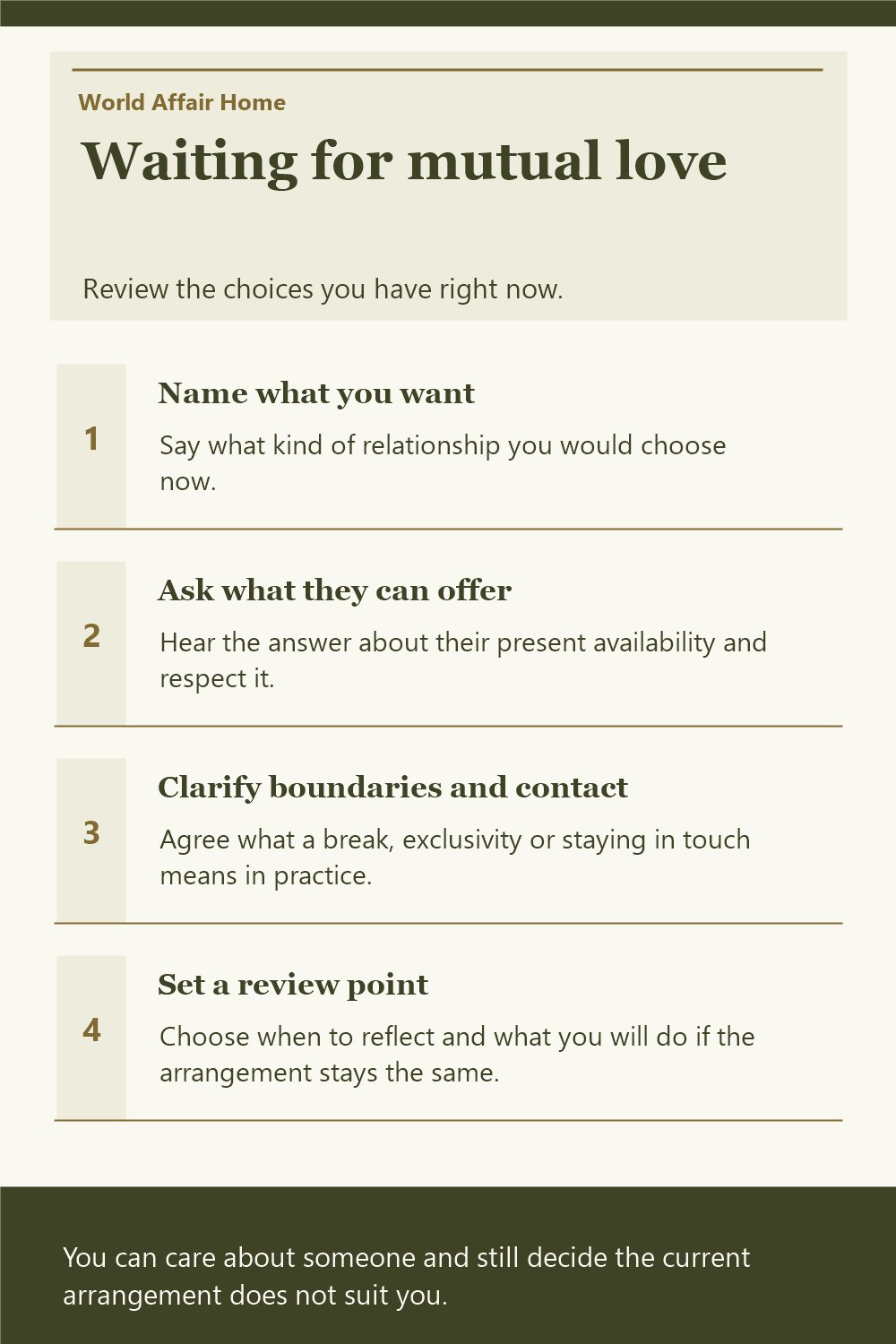
Waiting for mutual love
Review the choices you have right now.
- Name what you want Say what kind of relationship you would choose now.
- Ask what they can offer Hear the answer about their present availability and respect it.
- Clarify boundaries and contact Agree what a break, exclusivity or staying in touch means in practice.
- Set a review point Choose when to reflect and what you will do if the arrangement stays the same.
You can care about someone and still decide the current arrangement does not suit you.