

After heartbreak or a run of disappointing dates, stepping back from romance may feel necessary. You might want rest, greater clarity or a different kind of connection. Some people choose single life for a while or for the longer term, and that choice deserves respect.
There is no single explanation for why someone “gives up on love.” These ten possibilities are prompts for reflection, rather than a diagnosis of your personality. Consider which fit your experience and what you would like next. Love and belonging can also include friendship, family and community.
On this page
- You want more certainty
- You are protecting yourself after hurt
- Commitment means different things
- Your capacity is limited
- The dating setting does not suit you
- Preferences and needs feel tangled
- Comparison creates pressure
- Conflict feels like failure
- Other priorities need attention
- You need a different choice or boundary
1. You want more certainty
Getting to know someone involves unanswered questions. You may feel discouraged when attraction does not quickly become a reliable relationship. That does not make you impatient or mean you should accept endless ambiguity.
Ask a specific question about what is available now: “Are you interested in dating?” or “What kind of relationship are you looking for?” Consider whether their actions match the answer. You can take time to learn about someone while deciding how much uncertainty works for you.
2. You are protecting yourself after hurt
After betrayal, rejection or loss, privacy can feel protective. You may want to move slowly or avoid dating for a while. Sharing every feeling immediately is not a requirement for being sincere.
If you want to build a connection, choose something you feel comfortable sharing and notice how the other person responds. Respectful listening and keeping an agreed confidence can matter more than pressure to be vulnerable. You can keep limits while deciding whether trust is growing.
3. Commitment means different things
One person may want exclusivity, another a casual connection and another time to decide. A difference in expectations can make dating painful without revealing anyone’s secret motives. Check what each person means rather than assuming they are afraid or waiting for someone better.
Discuss expectations freely and clearly, including any existing agreements with other people. You do not have to persuade someone into the relationship you want. If the available arrangement does not fit your needs, stepping back is a reasonable option.
4. Your capacity is limited
Work, caregiving, health, finances and rest can affect the energy you have for a relationship. Attending to those needs does not make you selfish. It is more useful to be honest about your capacity than to promise contact you cannot manage.
If you are dating, consider a plan that fits both people: a shorter meeting, a clearer communication arrangement or fewer commitments. Ask about the other person’s needs too. A relationship requires room for mutual care, including the option to recognise a mismatch.
5. The dating setting does not suit you
An app, a noisy venue or an introduction through friends may feel more tiring than enjoyable. The setting alone cannot tell you whether the people there are superficial or capable of commitment. Think about what specifically makes the experience difficult.
You could try a quieter meeting, a shared-interest activity or a break from the app. Consider cost, access, privacy and safety when choosing. Trying another setting is optional; you can spend time with friends or enjoy an activity without treating everyone you meet as a potential date.
6. Preferences and needs feel tangled
Some wishes may be flexible, such as a shared hobby or a particular style. Other needs may be central to compatibility: respectful behaviour, consent, relationship structure or whether you want children. You are allowed to care about attraction too.
Ask which differences you genuinely want to explore and which would require giving up something important. Openness does not require dating someone you do not want to date. Compromise works best when it is freely chosen and does not undermine safety or dignity.
7. Comparison creates pressure
Stories, social media and other people’s milestones can make your own experience seem late or inadequate. You usually see only part of another relationship. A photograph or anniversary post does not show every conversation, resource or difficulty behind it.
Notice the expectation you are placing on yourself: a certain age, an impressive proposal or an effortless connection. Consider whether it reflects what you want now. You can enjoy a romantic story while making decisions from what is actually happening in your life.
8. Conflict feels like failure
A disagreement may leave you wondering whether a relationship is worth continuing. Look at how the disagreement is handled: can both people speak, listen, take responsibility and consider a change? Repeated promises without follow-through provide different information from a specific repair.
The NHS guidance on healthy relationships discusses honest communication, boundaries and taking a pause during conflict. You do not have to call a painful experience a gift or keep a relationship simply because effort has already gone into it.
9. Other priorities need attention
A course, recovery, a move or caring for someone may take priority over dating. You do not have to keep looking for romance to prove that your heart is open. A pause can be a considered decision rather than a permanent prediction.
If a rigid deadline is making you unhappy, review it alongside your circumstances and hopes. Keep practical information where it matters, and seek appropriate advice about important decisions. You can reconsider a plan without promising that love will arrive at a particular time.
10. You need a different choice or boundary
Sometimes discouragement points to a relationship that does not fit or behaviour that is harmful. Threats, coercion and control deserve attention. The NHS domestic abuse guidance describes signs and support options; seek suitable local help with safety, including emergency help when needed.
At other times, you may simply prefer being single or want a different form of connection. You can honour that preference while maintaining relationships that matter to you. Choose a next step that supports your needs now, with room to change your mind later.
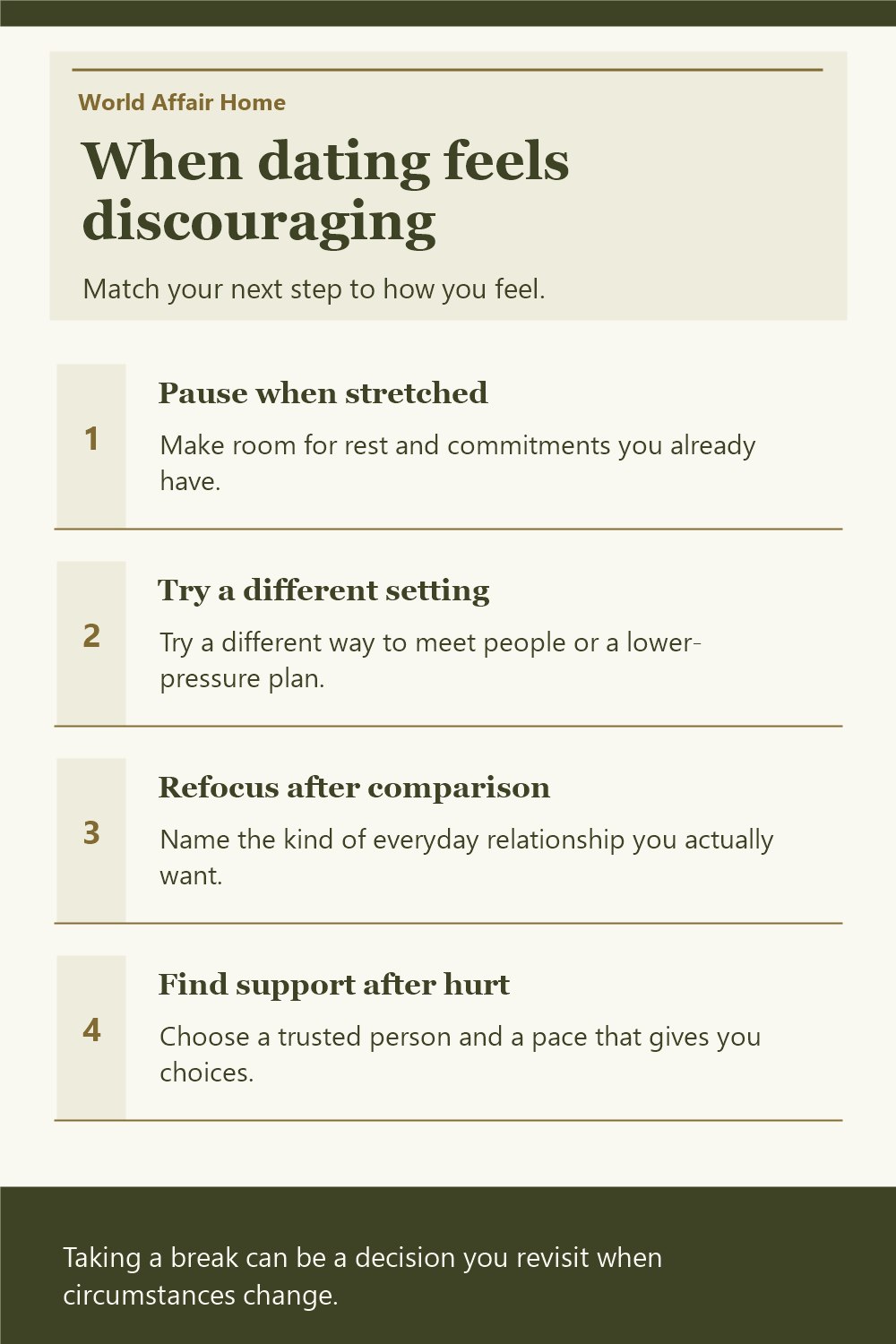
Read the infographic in text
When dating feels discouraging
Match your next step to how you feel.
- Pause when stretched Make room for rest and commitments you already have.
- Try a different setting Try a different way to meet people or a lower-pressure plan.
- Refocus after comparison Name the kind of everyday relationship you actually want.
- Find support after hurt Choose a trusted person and a pace that gives you choices.
Taking a break can be a decision you revisit when circumstances change.