

Feeling alone in a relationship can be painful, especially when you keep making plans, checking in or trying to repair things. You may wonder whether to ask for change, step back or leave.
You do not have to prove that the other person is “fine losing you” to take your own needs seriously. Start with what you can observe, what you want and what options are available to you.
On this page
Name the pattern you are noticing
Look at a few specific examples instead of trying to prove what someone secretly feels. Perhaps you initiate almost every conversation, plans are repeatedly cancelled without an alternative, or your concerns are dismissed when you raise them.
A difficult week and a long-running pattern deserve different responses. Illness, caring responsibilities, disability or work demands can affect what someone can offer. Context matters, and your needs still matter. Write down what is happening and how it affects you without turning the exercise into constant monitoring.
Make a clear request when it feels safe
If you want to explore whether things can change, choose one workable request. For example: “I’ve arranged our last few meetings, and I’m feeling alone in making plans. Would you choose and arrange something for us next week?”
Ask what they can realistically offer, too. The aim is an honest discussion of capacity and willingness. You do not have to find perfect wording before your concern deserves consideration, and you do not owe repeated conversations after making a decision.
Look at their response and follow-through
Notice whether they listen, ask questions, offer a realistic alternative or acknowledge a missed commitment. A promise may be sincere, but you still need to see what happens afterward.
Agreeing to a particular plan gives you something concrete to review. If circumstances change, can they communicate that and make another arrangement? If every conversation returns to blaming you for having needs, you can take that pattern seriously without diagnosing them or establishing their intentions.
Set a limit you can act on
A boundary describes what you are willing to participate in and what you will do. It cannot make another person care or force them to agree.
For example: “I won’t keep evenings open without a confirmed plan,” or, “If this turns into insults, I’ll end the conversation and decide later whether I want to return to it.” Choose a limit that fits your circumstances. Love is respect explains the importance of being able to express boundaries without fear.
Consider staying, stepping back or leaving
You might try a specific change, reduce your involvement, take space or end the relationship. You do not have to stay because the other person has a good explanation, and you do not have to leave on someone else’s timetable.
If shared housing, money, children or other responsibilities make the decision complicated, identify the practical questions separately. Appropriate individual support can help you consider your options. No conversation, deadline or self-improvement routine can guarantee that another person will change.
Feeling sad or missing someone afterward does not automatically mean your decision was wrong. You can grieve the connection and still want different treatment.

Prioritize support if there is fear or control
Threats, intimidation, stalking, controlling access to money or retaliation for saying no call for a different approach from an ordinary disagreement about effort. You do not have to confront someone or announce a boundary to prove that you tried.
A domestic abuse advocate can help you consider safer options privately. If your device or accounts may be monitored, think about a safer way to seek help; The Hotline’s technology-safety guidance explains why private browsing does not erase all traces. In immediate danger, contact local emergency services when you can do so safely.
For a first step today, tell one trusted person what kind of help you want: listening, company, practical planning or support finding a local service. You deserve room to decide what comes next.
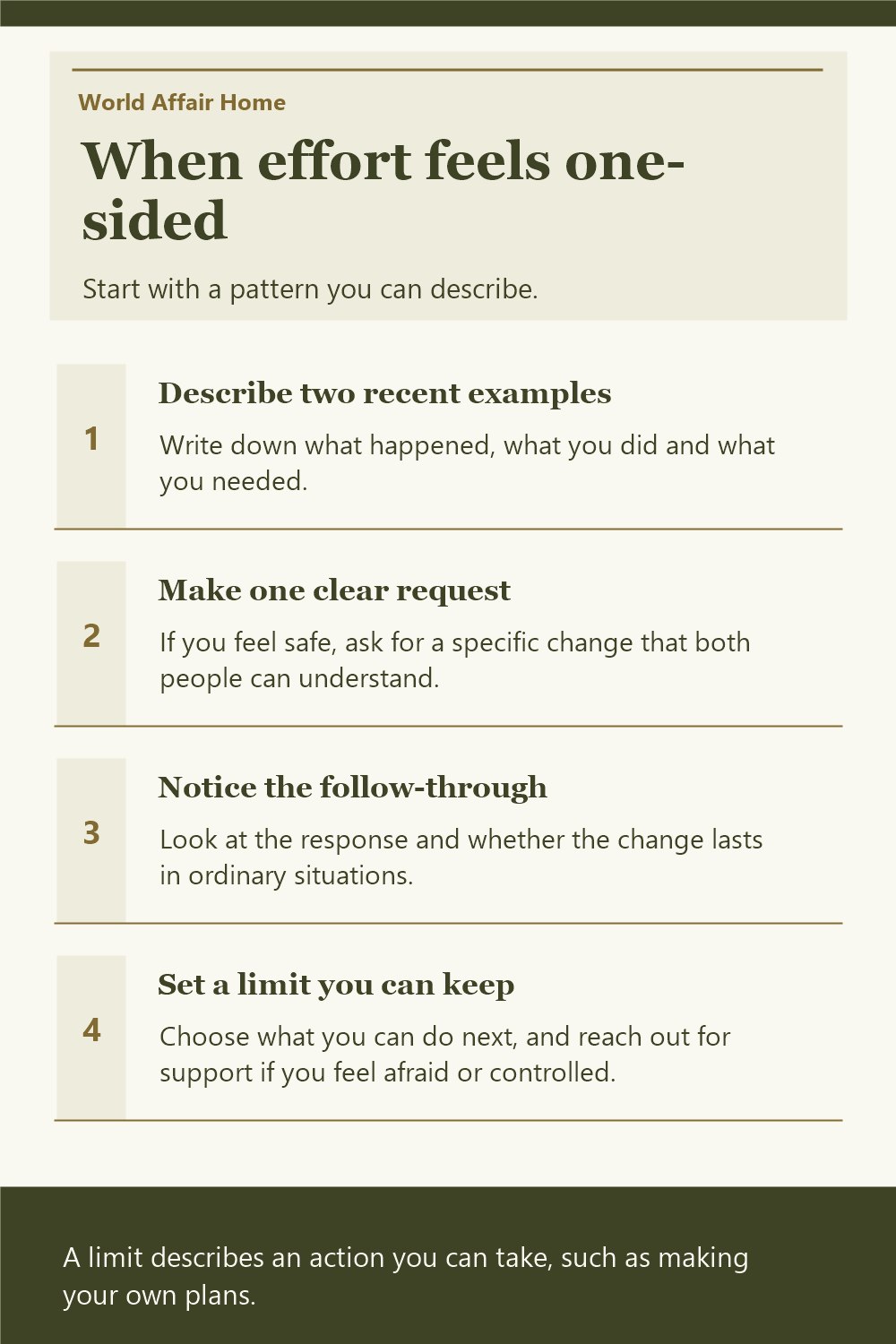
Read the infographic in text
When effort feels one-sided
Start with a pattern you can describe.
- Describe two recent examples Write down what happened, what you did and what you needed.
- Make one clear request If you feel safe, ask for a specific change that both people can understand.
- Notice the follow-through Look at the response and whether the change lasts in ordinary situations.
- Set a limit you can keep Choose what you can do next, and reach out for support if you feel afraid or controlled.
A limit describes an action you can take, such as making your own plans.