

Learning that someone you like recently ended a relationship can raise questions. Are they interested in you, looking for company, unsure what they want or ready for something committed? The timing alone cannot answer for them.
You cannot turn yourself into the right person through patience, delayed sex or a particular dating schedule. These six conversations can help you understand what is being offered and whether it fits what you want.
On this page
Ask what each of you wants now
Start with the present rather than a prediction about the future. You might say, “I enjoy seeing you. What kind of relationship are you interested in at the moment?” Share your own answer too.
Someone may want casual dates, exclusivity, time to get to know you or no commitment. Ask what they mean in practical terms. A label such as “rebound” does not supply that information.
Listen to a clear answer even when it is not the one you hoped for. “I am not looking for a relationship” is not a challenge to become more appealing or provide enough support to change their mind.
You can also be uncertain. Say what you know and what you are not ready to promise, then consider whether the arrangement is acceptable to both people.

Choose a pace that fits both lives
Discuss how often you want to meet, how to make plans and what contact feels manageable. There is no universal number of dates per week that makes a new relationship healthy.
A recent breakup may involve work, moving, parenting, grief or other practical demands. Ask what the person can realistically offer without assuming that every limit means lack of interest.
Your needs matter alongside theirs. You do not have to accept an arrangement that repeatedly leaves you waiting, cancel your own plans to be available or take responsibility for managing all their feelings.
Try one concrete agreement and revisit it: “Let us make a plan for next weekend rather than checking every evening.” You can slow down, ask for a different arrangement or decide that the available pace does not fit.
Discuss intimacy and exclusivity separately
Sex, exclusivity and commitment are different decisions. Having sex does not establish a shared relationship agreement; waiting does not guarantee deeper affection or a lasting partnership.
Talk about what each person wants and what you are comfortable with. Do not assume that dating profiles, contact with other dates or the word “casual” mean the same thing to both people.
Physical intimacy needs ongoing, freely given consent. RAINN’s guide to consent explains that previous agreement does not remove the right to pause or change your mind.
You can decline sex or a non-exclusive arrangement without needing to prove that your preference is correct. The other person can have a different preference, and you can decide whether your needs fit.
Talk about the past without becoming an investigator
It can help to discuss what someone learned from the previous relationship and what they want to do differently. Neither person has to provide every intimate detail, old message or account password.
Ask about practical matters that affect the present, such as ongoing contact over children, a home, work or belongings. Necessary contact with an ex does not by itself establish romantic involvement.
Consider whether the current situation is clear enough for you to choose. If someone says the earlier relationship has ended but asks you to participate in secrecy that makes you uncomfortable, ask about the actual circumstances rather than relying on reassurance alone.
You are a person they are dating, not a substitute counsellor or someone responsible for repairing the old relationship. You can listen with care while setting limits on conversations that leave little room for getting to know each other.
Choose introductions for a reason
Meeting friends or family can be meaningful, but it is not a test that proves commitment. There is no fixed waiting period that makes an introduction appropriate for everyone.
Discuss why you want the introduction, what the other person is comfortable sharing and how you would describe the relationship. Avoid surprising someone with a major event or announcing a status you have not agreed on.
If children are involved, consider their routines and needs separately from adult excitement. Seek advice suited to your family when needed, and avoid asking children to validate the relationship or keep adult secrets.
You can postpone an introduction while continuing to date, or decide that differing expectations about being included matter to you. Ask what the choice means rather than assuming that a particular milestone settles everything.
Review the arrangement and leave room to choose
After some time together, ask whether the arrangement still matches what you both want. Are agreements happening? Can you discuss concerns? Is there room for your interests and needs as well as the recent breakup?
Look at observable behaviour rather than hoping that enough waiting will produce a different answer. Affection can be real even when the relationship being offered does not work for you.
You can continue, change the pace, pause or end dating. A clear statement such as “I want a committed relationship, and this arrangement does not fit” does not require blaming the other person for being newly single.
If you are afraid of threats, coercion or unwanted contact, seek individual safety support before a confrontation. Your next step should leave room for practical support and your own choice, not a promise that a particular romance must succeed.
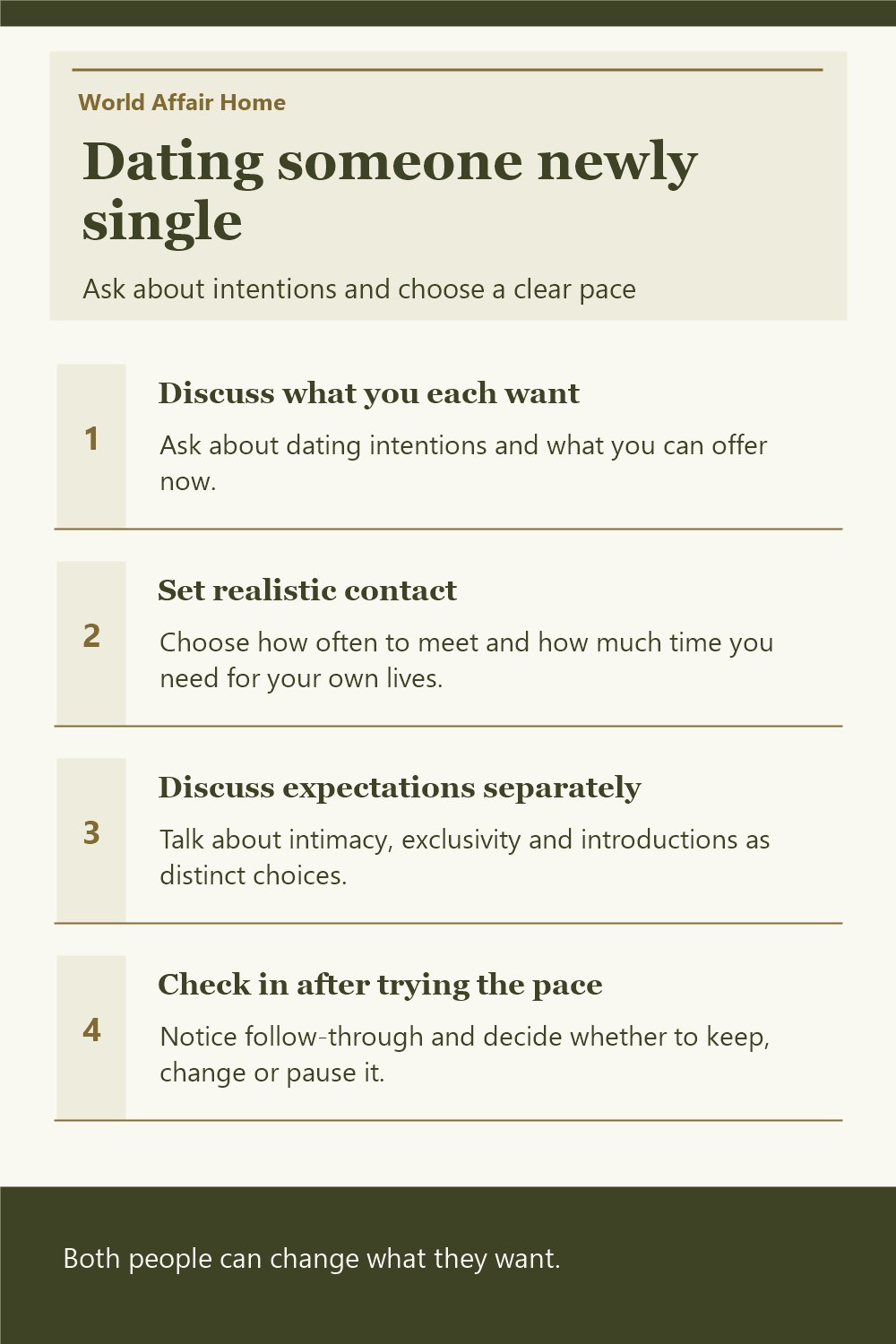
Read the infographic in text
Dating someone newly single
Ask about intentions and choose a clear pace
- Discuss what you each want Ask about dating intentions and what you can offer now.
- Set realistic contact Choose how often to meet and how much time you need for your own lives.
- Discuss expectations separately Talk about intimacy, exclusivity and introductions as distinct choices.
- Check in after trying the pace Notice follow-through and decide whether to keep, change or pause it.
Both people can change what they want.