

Discovering an affair can make ordinary decisions feel difficult. Start with what needs attention now—your safety, basic care, sexual health and practical support—while giving yourself room to decide what you want from the relationship.
You may want answers, distance or both. Neither an apology nor pressure from other people requires an immediate promise to stay, forgive or leave.
Separate urgent needs from later decisions
You can choose a next step without settling the future of the relationship.
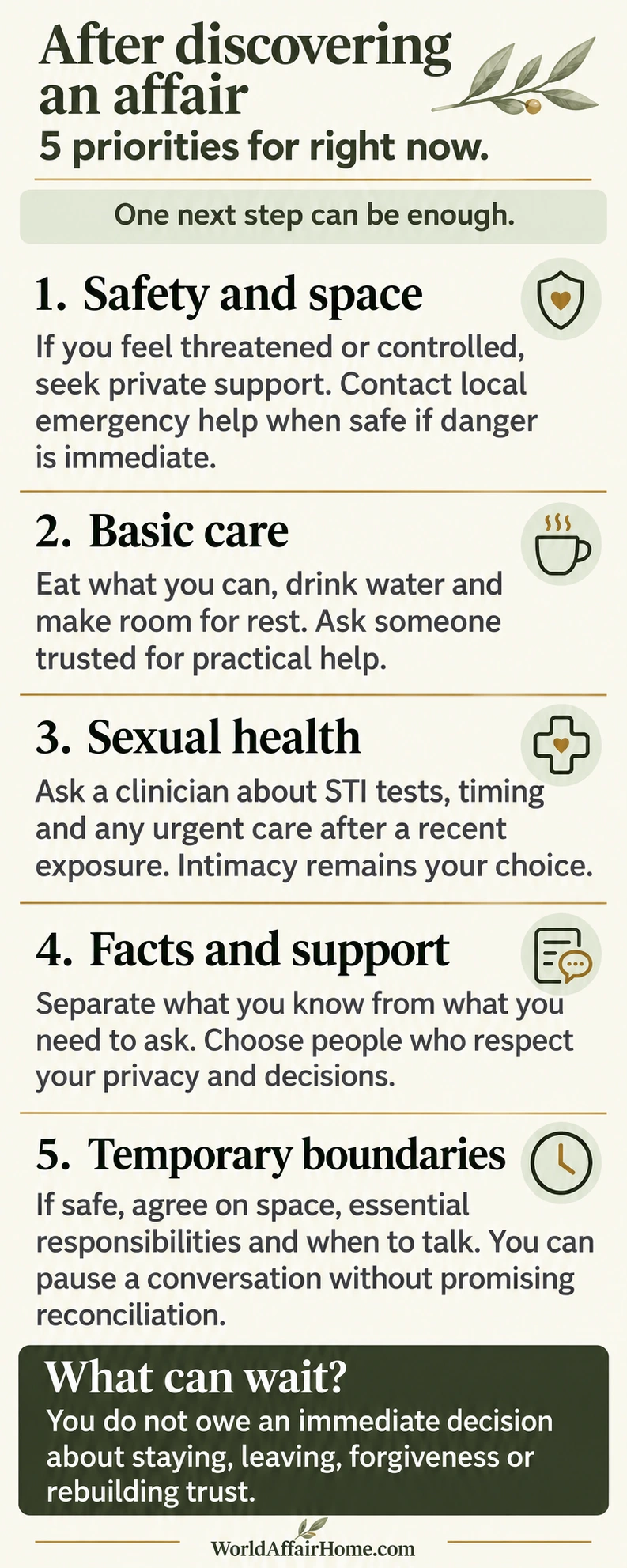
Read the five priorities as text
- Safety and space. If you feel threatened or controlled, seek private support. Contact local emergency help when safe if danger is immediate.
- Basic care. Eat what you can, drink water and make room for rest. Ask someone trusted for practical help.
- Sexual health. Ask a clinician about STI tests, timing and any urgent care after a recent exposure. Intimacy remains your choice.
- Facts and support. Separate what you know from what you need to ask. Choose people who respect your privacy and decisions.
- Temporary boundaries. If safe, agree on space, essential responsibilities and when to talk. You can pause a conversation without promising reconciliation.
What can wait? You do not owe an immediate decision about staying, leaving, forgiveness or rebuilding trust.
More help: discussing STI testing with a healthcare professional and finding support and taking time after an affair.
Safety Comes First
If your partner threatens you, tries to block you from leaving, damages property, or controls you, you should get support right away. An emotionally charged confrontation can cause more danger. You don't need to say everything that's going on to get help.
If you're not in danger, pick a conversation that's good right now. You might say, "I have enough information to be upset. I need to rest tonight without talking about it. We can decide to talk about it tomorrow." This is a temporary time limit, not an agreement that you're ignoring the situation.
Don't have a major conversation when you're driving, caring for your children, or not able to leave the room. If either person is intoxicated, wait until later to have a discussion. Urgency doesn't make feeling unsafe better.
If you're in any kind of danger, contact local emergency services when you can. If fear or coercion is present, a domestic violence advocate can help you understand your options.
Start with food, rest and ordinary care
You don't have to have a perfect wellness routine, but try something basic: get yourself something to drink, some food you can tolerate, and your regular medications. Take time to rest and ask someone to sit with you if that feels useful.
If you learn about an affair before a work presentation, for example, instead of deciding whether you should end your marriage tonight, ask a friend to bring you breakfast and help you request a day's leave. The problem right away is getting through to the next day.
Try to avoid using alcohol or other substances to force yourself to sleep or to numb out the feelings. If you're struggling with sleep, eating, working, or stress, talk to a healthcare professional. You don't have to wait until you're feeling completely out of control to get help.
Comfort can be something small like a meal that is familiar to you, getting a shower, or going for a walk with a friend. This can be more helpful than trying to understand the betrayal right away.
Finding Support Without Letting Others Make Your Decisions
When you're going through something difficult in your relationship, having someone to talk to can make a big difference. Try reaching out to one or two people you trust who will listen without telling you what you should do. You can even explain what kind of support you need by saying something like, "I really need someone to talk to right now, but I don't want you contacting my partner or sharing what's happening with anyone else." This helps you set boundaries while still getting the support you need.
You also don't have to tell everyone what's happening in your relationship. Sometimes sharing too much with friends or family can make things more complicated, especially if you decide to stay and work things out. However, you shouldn't feel that you have to keep everything a secret just to protect your partner's reputation. There's a difference between wanting privacy and feeling like you're not allowed to talk about what you're experiencing. You deserve to have people you can turn to when things get difficult.
It can also help to have different people you rely on for different kinds of support. Maybe you have a close friend who listens when you need to talk, a family member who can help with everyday responsibilities, or a professional who can answer questions about things like finances, legal concerns, or emotional well-being. You don't have to expect one person to understand everything or have all the answers.
Remember that even people who care about you might have strong opinions about what you should do. Some might tell you that you should immediately leave, while others might believe that you should forgive your partner and try to make things work. However, they're not the ones who have to live with your decision. Your circumstances, feelings, responsibilities, and safety all matter. The people supporting you should help you think through your options instead of making you feel pressured to pick the decision they would make.
Understand What You Know Before Making a Decision
When you find out that your partner has been unfaithful, it's easy to feel overwhelmed by everything going through your mind. You might have questions about what happened, worry about what you don't know, or feel pressured to decide whether you're going to stay or leave. Instead of trying to figure everything out at once, it might help to write things down and separate what you know from what you're still trying to understand.
One way to do this is to divide a piece of paper into three sections. In the first section, write down the things you know are true. In the second, write the questions you still have. In the third, write down decisions that you don't have to make immediately. For example, if your partner admitted to being physically involved with someone else, that would go in the first section. If you're wondering whether they're still communicating with that person, that would go in the second. Deciding whether you want to continue the relationship would go in the third.

Some questions might need to be answered sooner than others. You might need to know whether your partner is still involved with the other person, whether there are sexual health concerns, or whether shared money was spent without your knowledge. You might also need to discuss living arrangements or responsibilities at home. However, you don't have to ask for every detail about the affair right away, especially if knowing those details isn't going to help you make a decision.
Writing everything down doesn't guarantee that you'll get honest answers, but it can help you organize your thoughts and recognize what information you actually need. Sometimes asking question after question can leave you feeling even more confused, especially when each answer brings up something else you want to know. Give yourself time to understand what's happened, decide which questions matter most, and think about what you need moving forward. You don't have to make every decision about your relationship in one conversation.
Talking About Sexual Health
If there was an affair, sexual exposure may have happened. You can pause sexual activity and ask a healthcare professional about appropriate testing, timing and any time-sensitive care. Just because your partner reassures you or they don't show symptoms doesn't mean there's no risk.
CDC guidance on STI testing recommends discussing your sexual history with a healthcare provider to determine appropriate tests. Testing needs vary, and a single immediate result may not answer every question about a recent exposure.
You can explain that you are arranging medical advice and choosing whether to pause sexual contact while you consider the guidance. You don't have to use intimacy to prove forgiveness or to compete with someone else. This also should be something to discuss with the person who broke trust.
If an exposure happened recently, get medical advice right away instead of waiting for a relationship conversation. Your doctor can look at the situation. Don't self-diagnose, pick treatments from social media, or treat a test as a moral judgment.
Keep useful records lawfully
You might need to understand the bills, open an account, and look at insurance or housing. Look at the information you're legally allowed to access and keep your own records.
Don't hack into accounts, install tracking devices, or impersonate someone. These are actions that can cause leaks, safety problems, and keep you locked in surveillance continuously.
If shared money is being spent or hidden, get qualified legal or financial help before you make changes. Don't just drain joint accounts, cancel important insurance, or move the children based on online advice.
Find out what kind of information you need to make a decision. This might mean knowing that rent is due or how to access your own paycheck. It doesn't always mean that you look at every message that has come in to understand the relationship.
Set Some Boundaries While You Figure Things Out
When you're dealing with infidelity, sometimes making temporary arrangements can help you get through the first few days without having to argue about every little thing. You might need to talk about where each person will sleep, who will take care of the children, how household responsibilities will be handled, and when you're willing to discuss what happened. These arrangements don't have to be permanent. They're simply a way to give both of you some space while you decide what comes next.
Try to be clear about what you need instead of making general statements that could be misunderstood. For example, you might say, "For the next few days, I'm going to sleep in the other bedroom. If we need to talk about bills or the kids, please text me. I also don't want to have conversations about our relationship late at night." This lets your partner know what you're comfortable with without making it seem like you've already decided whether you're staying or leaving.
If your partner is still in contact with the person they were unfaithful with, that's something you'll need to address if you're considering working on the relationship. Sometimes contact might be difficult to avoid, especially if they work together, but that doesn't mean you have to accept vague explanations or promises. You have a right to ask questions about what kind of contact is happening and what boundaries would need to be in place for you to feel comfortable moving forward.
Remember that boundaries only work when they're respected. If you and your partner agree on something and they continue ignoring it, pay attention to their actions. You shouldn't have to keep explaining the same reasonable boundary over and over just to get someone to respect it. What they actually do can tell you more about their willingness to work on the relationship than what they promise.
Protect Your Children from Relationship Problems
Children can often tell when something is wrong between their parents, even when nobody explains what's happening. They might notice changes in the household, hear disagreements, or realize that one parent seems upset. If this happens, try to give them a simple explanation that fits their age without sharing details about the affair. You might say something like, "We're having some problems right now, but these are adult problems, and you haven't done anything wrong. We're going to make sure you're taken care of."
It's important not to put children in the middle of relationship problems. They shouldn't be asked to check on a parent, carry messages, keep secrets, or decide whose side they're on. Even if you're feeling hurt or angry, try not to share details that could make them feel responsible for comforting you or rejecting their other parent. Children need to know that they're allowed to love both parents without feeling guilty.
If something about their routine is going to change, explain what you know instead of making promises about things you haven't decided yet. For example, you could tell them, "You'll be staying here tonight, and I'll be taking you to school in the morning." This gives them information they can understand without creating expectations about what will happen with the relationship.
Sometimes children might need more help understanding the changes happening around them. A counselor or family therapist can help parents find age-appropriate ways to communicate and support their children. The goal isn't to pretend that everything is perfect. It's to make sure children feel loved, safe, and supported while the adults work through their own decisions.
Think Carefully Before Sharing Everything Publicly
Finding out that your partner has been unfaithful can bring up a lot of anger, hurt, and frustration. You might feel tempted to post about what happened on social media, contact the other person's family or employer, or send messages to everyone involved. Sometimes sharing information might be necessary, but once something becomes public, it can be difficult to take back. It could also affect children, family members, or other people who weren't involved in the relationship.
Before posting or sending anything, think about what you're hoping to accomplish. Are you looking for emotional support? Do you want someone to understand what happened? Are you trying to protect yourself, or are you hoping that exposing the situation will make the other person feel the same hurt you're experiencing? Asking yourself these questions can help you decide whether sharing the information will actually help or make things more complicated.
You have every right to feel angry about being betrayed, and you don't have to pretend that what happened was acceptable. However, giving yourself some time before making something public doesn't mean you're protecting your partner or excusing their behavior. It means you're giving yourself an opportunity to decide what information you want to share, who needs to know, and whether sharing it will help you in the long run.
For example, imagine that Kevin discovers his partner has been unfaithful and immediately wants to send a long message to both families explaining everything that happened. Instead of sending it while he's upset, he writes down everything he wants to say and saves the message. After talking with a counselor and thinking about what he wants to accomplish, he decides to send a shorter message to the family members who need to know about changes in their plans. He shares only the information that's necessary without involving everyone in the personal details.
This example shows that you can be honest about what happened without feeling that you have to tell everyone every detail. Sometimes taking a little time to think before responding can help you protect your privacy, avoid unnecessary conflict, and make decisions that are better for you moving forward.
Getting Professional Help
Getting counseling can give you a place to process the shock and look at your options. Couples therapy might be needed when both partners are willing to participate in a safe setting. It should never be a condition you have to meet before you are allowed to leave.
When there is abuse or coercive control, joint therapy can create risks. The National Domestic Violence Hotline explains why it does not recommend couples counseling with an abusive partner. Private, specialist support may be a safer starting point.
Ask any couples therapist about their experience with accountability, confidentiality, and betrayal. A therapist should not guarantee reconciliation or treat the betrayed partner’s distress as the only problem to resolve.
You can get help to make a decision instead of saving the relationship. You can also decide later that the kind of help that you needed has now changed.
Pay Attention to Behavior
A big apology is like an event, but repair is something that involves behavior as time goes on. Pay attention if your partner answers questions honestly, respects a pause, or accepts responsibility without blaming you.
You're allowed to forgive when you're ready. You don't have to promise to stay just because your partner starts changing. Effort can matter without creating an obligation.
Think of what would help you feel clear. I suggest keeping an appointment, keeping track of spending, showing respect for your social boundaries, or having a hard conversation without feeling intimidated. These are useful observations, not a test that can predict whether repair will succeed.
Pay attention to your own experiences. Are you getting enough room to think, and can you disagree with your partner safely? Are you picking the next action step, or being forced to hurry so that someone doesn’t feel uncomfortable?
Choose a manageable next step
Select the pressure point that needs attention first to get a short set of practical prompts.
If you fear threats or retaliation, seek private support rather than using a conversation script to confront your partner.
Use the questions and examples in the article above; the draft builder needs JavaScript.
15 questions readers ask
1. Do I have to decide whether to stay immediately?
No. You can address urgent needs and set temporary arrangements while leaving the larger decision open. Safety or practical deadlines may require action sooner.
2. What should I prioritize on the first day?
Check safety, essential care and immediate responsibilities. Ask one trusted person for a specific kind of support, such as a meal, company or help with childcare.
3. Is there a correct emotional response?
People may feel anger, grief, numbness, relief or a changing mixture. Your immediate reaction does not determine what decision you must make.
4. Should I confront my partner right away?
Consider whether a conversation is safe and useful now. Avoid discussing it while driving, intoxicated or unable to leave. Fear or threats call for private specialist support.
5. Which questions need answers first?
Focus on information that affects health, ongoing contact, shared money, housing and responsibilities. You do not need every intimate detail to begin making practical choices.
6. Should I consider STI testing?
Ask a healthcare professional about your circumstances and timing. Many STIs have no symptoms, and one immediate test may not settle every question about recent exposure.
7. Do I owe my partner sex to show forgiveness?
No. Sexual contact must remain freely chosen. You may pause intimacy, seek medical advice or change your mind without proving anything about reconciliation.
8. Who should I tell?
Choose people who can respect your privacy and decisions. You can ask for support without allowing anyone to contact your partner or share details on your behalf.
9. How much should children be told?
Give age-appropriate information about changes that affect them. Keep affair details and adult disputes out of their responsibilities; reassure them they did not cause the problem.
10. Can temporary sleeping or contact arrangements help?
They can reduce repeated negotiations when safe. Be specific about duration, childcare, bills and the times you are willing to discuss the relationship.
11. Should I check every message or account?
Use only information you are lawfully entitled to access. Hacking, impersonation and secret tracking create additional risks and cannot guarantee honesty.
12. Should I post about the affair publicly?
Pause to consider your purpose, privacy and effects on children or others. Seeking private support does not require making every detail public.
13. Can couples therapy help after an affair?
It may be an option when both people freely participate and it is safe. Ask about relevant experience and confidentiality; reconciliation should not be promised.
14. When might joint therapy be unsafe?
Abuse, coercive control or fear of retaliation can make joint sessions risky. Private advice from a domestic violence specialist may be a safer starting point.
15. What if I still do not know what I want?
You can choose one next step without a final verdict: medical advice, a support conversation, clearer information or more space. Revisit decisions as you learn more.