

You may enjoy getting to know a coworker and wonder whether to suggest a date. Shared work does not tell you whether the interest is mutual, or whether a relationship would be appropriate in your situation.
Before acting, consider workplace rules, power differences and whether both people can make a free choice. These checks can help you think it through without assuming that a romance will either improve your work or ruin your career.
On this page
- Read the relevant workplace policy
- Take power and dependency seriously
- Leave room for a clear, pressure-free answer
- Discuss what each person is choosing
- Separate privacy from required disclosure
- Protect fairness and work boundaries
- Think about what happens if dating ends
- Take unwanted conduct and reporting seriously
Read the relevant workplace policy
Check your employer’s rules about personal relationships, conflicts of interest, reporting responsibilities and harassment. Look for requirements that apply to your role rather than relying on office rumours.
If something is unclear, ask an appropriate policy contact a general question about the rule and the process. Find out who would receive information and what would happen next before assuming a conversation is confidential.
Policies and legal requirements differ by workplace and location. Do not treat advice from another company as permission to ignore yours, and do not make an immediate decision to resign simply because the situation feels awkward.

Take power and dependency seriously
Consider whether either person influences the other’s pay, shifts, promotion, appraisal, training, contract or access to work. A difference in authority can make it difficult to decline or change one’s mind freely.
If you manage the person, supervise their work or otherwise control an important opportunity, do not use that position to pursue romance. Seek guidance about the conflict before taking any romantic step; changing reporting arrangements may not resolve every concern.
The same questions can arise outside a formal manager title. Consider practical influence, job insecurity and whether someone could reasonably fear a work consequence for saying no.
Leave room for a clear, pressure-free answer
Friendly conversation, professional helpfulness or contact required for work does not establish romantic interest. First consider whether an invitation is appropriate under the policy and circumstances.
If it is appropriate, keep any invitation simple and easy to decline: “Would you like to get coffee outside work? It is completely okay if not.” Do not use work access to arrange repeated private encounters or create an obligation.
Treat refusal, non-response or visible discomfort as a reason to stop pursuing the invitation. Continue necessary work communication courteously, without repeated requests, punishment or asking colleagues to persuade the person.
Discuss what each person is choosing
If interest is mutual and the workplace circumstances permit it, talk about what you each want. A date does not itself establish exclusivity, ongoing intimacy or agreement to share the relationship publicly.
Be honest about existing relationship commitments and agreements that affect the decision. Do not rely on vague assurances, secrecy or the hope that an unresolved situation will disappear.
Consent needs to remain freely given as circumstances change. Past affection or a previous date does not create permission for touching, sexual comments or personal contact at work.
Separate privacy from required disclosure
Agree what personal information you are comfortable sharing with colleagues. Do not publish messages, photos, intimate details or someone else’s relationship news without permission.
At the same time, a workplace may require disclosure of a relevant conflict or relationship. Follow the applicable process rather than making a promise of secrecy that conflicts with your responsibilities.
Ask how information will be handled and what steps may be required. Respect for privacy does not mean asking the other person to hide a concern, avoid reporting conduct or give up access to support.
Protect fairness and work boundaries
Discuss how you will keep work decisions, shared projects and professional communication fair. Do not exchange favourable shifts, opportunities, confidential information or influence for affection.
Use work systems in line with policy. Keep personal conversations from interfering with duties, and avoid making colleagues manage private arguments or take sides.
If a conflict affects an assignment or decision, raise it through the appropriate process. A private agreement to be professional is not a substitute for dealing with an actual conflict of interest.
Think about what happens if dating ends
Consider how you would handle necessary work contact if one person no longer wanted personal contact. You do not need to predict the outcome to recognize that both people still need to do their jobs.
Agree that ending a relationship will not become a reason for gossip, unwanted messages, exclusion or interference with work. Keep any practical conversation about projects separate from requests to restart the relationship.
If you cannot work out an appropriate arrangement, seek workplace guidance. A transfer or different reporting structure may be one option, but neither person should be pressured into an abrupt career decision to avoid discussing the issue.
Take unwanted conduct and reporting seriously
Do not assume that a report of harassment is a tactic, or judge its credibility from someone’s gender or past relationship. Anyone can experience unwanted conduct, including after previously welcoming a relationship.
The US EEOC’s employee questions and answers explain that harassment can affect anyone and can occur in virtual work as well as a physical workplace. Its guidance directs employees to check the employer’s reporting process; if confronting the person feels uncomfortable, raising the concern with the employer is an option.
In Great Britain, Acas explains sexual harassment and routes to support. The rules and available processes depend on your location, so seek advice suited to your situation rather than assuming one country’s guidance applies everywhere.
Keep an accurate record of concerning events and preserve information you are entitled to keep without accessing another person’s account or taking confidential workplace data. Ask an appropriate workplace contact, union representative or qualified local adviser about next steps. Do not promise that a particular complaint, investigation or legal outcome is guaranteed.
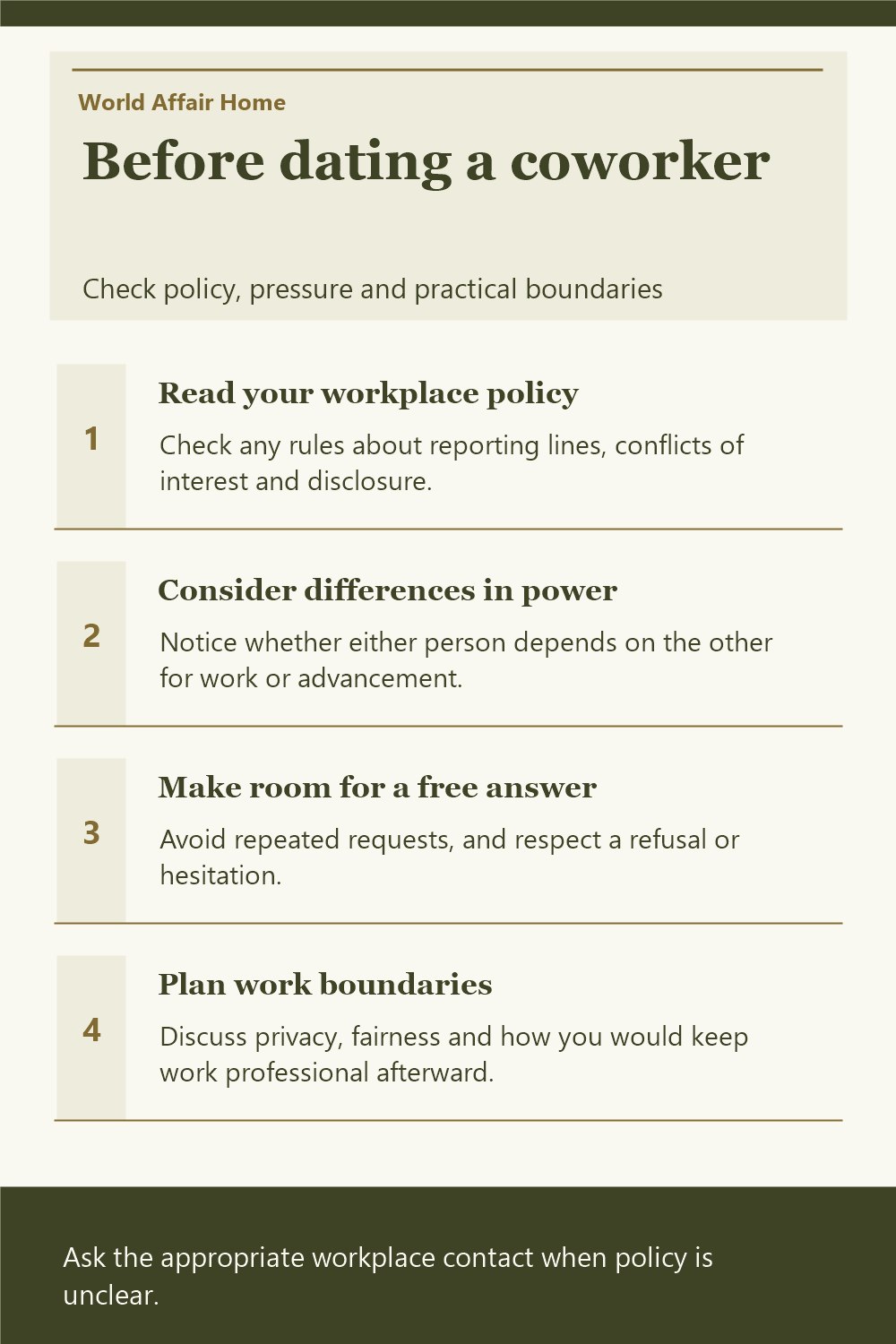
Read the infographic in text
Before dating a coworker
Check policy, pressure and practical boundaries
- Read your workplace policy Check any rules about reporting lines, conflicts of interest and disclosure.
- Consider differences in power Notice whether either person depends on the other for work or advancement.
- Make room for a free answer Avoid repeated requests, and respect a refusal or hesitation.
- Plan work boundaries Discuss privacy, fairness and how you would keep work professional afterward.
Ask the appropriate workplace contact when policy is unclear.