

A close friendship can make you wonder whether romance is possible. Shared jokes, frequent messages and affection can feel significant, but they do not tell you what another person wants.
The clearest next step is a conversation that leaves both people free to answer honestly. These questions can help you understand your own interest, avoid guessing games and decide what to do with the answer.
On this page
- Start with what they actually say
- Separate your feelings from their feelings
- Value the friendship on its own terms
- Avoid reading touch as permission
- Treat eye contact as context
- Do not turn body language into a verdict
- Notice contact without keeping score
- Avoid public tests and jealousy games
- Let introductions mean what they mean
- Discuss intimacy and relationship expectations separately
- Do not mistake jealousy for commitment
- Make one clear invitation
- Talk about what a yes would mean
- Accept the answer and choose your next step
Start with what they actually say
If someone has said they want friendship, take that seriously. Warmth, attention or a playful conversation does not cancel their answer. If no one has discussed the relationship, there may simply be uncertainty.
You can ask, “How do you see our connection?” Listen to the answer without treating it as the start of a negotiation.
Separate your feelings from their feelings
Wanting romance can make ordinary moments feel significant. Ask yourself what you want, then leave room for the other person to want something different. Your excitement, dreams or sense of spiritual connection can be meaningful to you without establishing their intentions.
Value the friendship on its own terms
Friendship can include affection, loyalty and emotional intimacy. Those qualities do not make it incomplete. A romantic relationship can include friendship, but neither person has to agree to romance to preserve a valuable connection.

Avoid reading touch as permission
A hug or familiar touch may have different meanings to different people. Do not test romantic interest by moving closer or touching someone without checking whether it is welcome. Ask before a new kind of physical contact and respect hesitation or a refusal.
Treat eye contact as context
Eye contact varies with personality, culture, comfort and disability. Looking away is not proof of disinterest; looking closely is not proof of attraction. Words and freely chosen plans are more useful than a rule about how long someone holds your gaze.
Do not turn body language into a verdict
Crossed arms, a smile, a changed voice or the direction someone’s feet point cannot settle whether they want to date you. They may be cold, distracted, nervous or simply comfortable. If you notice uncertainty, slow down and ask a straightforward question.
Notice contact without keeping score
Frequent messages can reflect friendship, romance, habit or practical needs. Rather than counting replies, consider whether the contact works for both of you. Neither a friend nor a partner owes constant availability, passwords or an immediate answer.
Avoid public tests and jealousy games
Flirting with someone else to get a reaction, making a public declaration or asking friends to pressure them can make an honest answer harder. Choose a private but comfortable conversation where either person can decline without an audience or pressure.
Let introductions mean what they mean
Meeting friends or family may show that you are important to someone. It does not establish a romantic agreement or exclusivity. If you are unsure how you are being introduced, ask rather than relying on what other people assume.
Discuss intimacy and relationship expectations separately
Sexual contact does not automatically establish dating, exclusivity or commitment. These need their own conversations. RAINN’s guidance on consent explains that agreement must be voluntary and ongoing; past intimacy or flirting does not establish consent now.
Do not mistake jealousy for commitment
A person can feel jealous without wanting a relationship, and a loving partner may not behave jealously. Rudeness toward your friends, monitoring or attempts to control who you see are concerns to address, not signs that you should pursue romance.
Make one clear invitation
If you want a date, use the word “date.” For example: “I enjoy being with you, and I’d like to ask you on a date. Would you be interested? It’s okay if you’d rather keep this as friendship.” Suggest a simple activity if they are interested.
An unclear answer is not agreement. You can say, “No need to decide now,” and continue your own plans rather than putting your life on hold.
Talk about what a yes would mean
If interest is mutual, discuss pace, privacy, physical boundaries and what you each want to explore. One date does not require an immediate commitment. You can agree how to handle shared friendships without making everyone else responsible for the outcome.
Care does not require unlimited sacrifice or immediate forgiveness after hurt. Both people should remain able to disagree, keep other relationships and decide whether dating suits them.
Accept the answer and choose your next step
If they decline, thank them for being clear and stop asking unless they independently reopen the conversation. You may need some space to let your feelings settle. Explain that without making distance a punishment or a way to change their mind.
If you want different kinds of connection, you can decide what level of friendship feels manageable. You do not need a secret sign or a prediction before having an honest conversation, and neither person owes the other a romantic relationship.
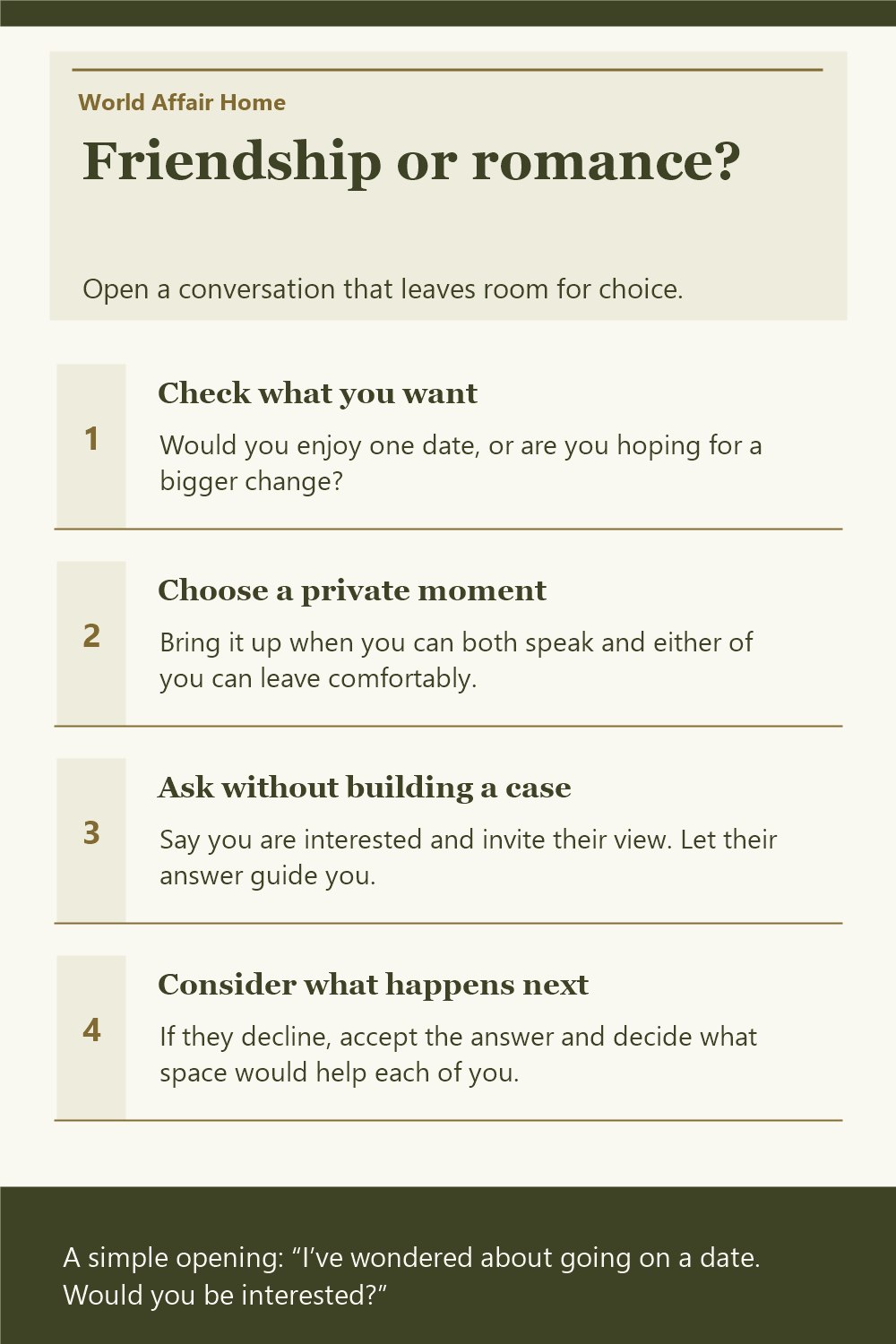
Read the infographic in text
Friendship or romance?
Open a conversation that leaves room for choice.
- Check what you want Would you enjoy one date, or are you hoping for a bigger change?
- Choose a private moment Bring it up when you can both speak and either of you can leave comfortably.
- Ask without building a case Say you are interested and invite their view. Let their answer guide you.
- Consider what happens next If they decline, accept the answer and decide what space would help each of you.
A simple opening: “I’ve wondered about going on a date. Would you be interested?”