

Having feelings for someone else while married can be confusing, exciting or upsetting. The feeling alone does not tell you whether to stay, leave or start a new relationship.
You can take your experience seriously while slowing down enough to consider your commitments, your safety and the people affected. Focus first on choices you can make deliberately, rather than treating attraction as an instruction.
On this page
Pause before making new promises
Give yourself some room to think before escalating contact or promising a future to the other person. A strong connection can feel urgent without requiring an immediate decision.
If contact is becoming intimate or secretive, consider stepping back while you work out what you want. With a colleague, that might mean keeping conversations work-related and avoiding private, romantic exchanges. Choose limits you can actually follow; do not ask the other person to wait indefinitely for an outcome you cannot promise.
Separate attraction from questions about your marriage
Ask two different questions: “What draws me to this person?” and “What is happening in my marriage?” Novelty, attention, affection, shared interests and dissatisfaction may each matter, but none tells the whole story.
Describe the marriage in concrete terms: how you communicate, share responsibilities, handle disagreements and spend time together. Ask what you would want to address even if the new person were unavailable. Reduced sex, a busy period or emotional distance does not by itself prove that love has ended or that either partner is having an affair.
Writing down what you know, what you assume and what you still need to discuss can help you avoid building a decision around a single interpretation.

Consider your agreements and the people affected
Review the agreements you and your spouse understand you have about exclusivity, intimate messages and relationships with other people. You cannot change those agreements for both of you by deciding privately that they no longer fit.
If you want a different arrangement, discuss it before acting on it. A spouse is free to decline. The other person also needs accurate information about your relationship status to make their own choices.
Think about practical responsibilities, including housing, money, children and care for others where relevant. These responsibilities deserve planning; they do not remove anyone’s right to leave. Keep children out of adult confidences, messages and pressure to take sides.
Plan an honest conversation when it is safe
Choose a time when you can talk privately without needing to rush. Start with what you know: “I have been feeling uncertain about our relationship, and I want to talk honestly about it.” If you have crossed an agreement, acknowledge that action without making your spouse responsible for it.
Avoid comparisons designed to hurt, promises you cannot keep and demands for an immediate response. You can pause an overwhelming conversation and agree when to return. A pause should not become a way to keep denying information that affects the other person’s choices.
If you fear violence, threats, monitoring or retaliation, prioritize individual safety support before disclosure or confrontation. The National Domestic Violence Hotline explains internet safety when someone may be monitoring your devices. Use a safer device if possible; private browsing cannot guarantee that activity is hidden.
Choose a next step you can explain clearly
You might explore whether both of you want to work on the marriage, take time with agreed arrangements, or begin planning a separation. The decision does not have to depend on whether the new connection becomes a relationship.
Be clear about what a period of reflection means: where you will live, what contact is agreed, which responsibilities continue and when you will talk again. Do not assume that living apart automatically changes your agreements about dating.
For legal, housing or financial decisions, get advice appropriate to your location and circumstances. A feeling of certainty about a new person is not a substitute for understanding a practical commitment.
If trust has already been broken
Take responsibility for the choices you made. Avoid asking your spouse to reassure you, forgive quickly or compete with the other person. They may want information, space, support or an end to the relationship.
Repair requires freely chosen participation and consistent action over time; neither an apology nor counselling guarantees reconciliation. Respect privacy and bodily autonomy while discussing what each person would need to continue. Checking devices or following someone is not a substitute for an agreement.
If you are trying to understand what comes next, read After Discovering an Affair: What to Prioritize First.
Get support for your own decision-making
A trusted person who can listen without directing your life may help you think. Individual counselling is another option; ask about the provider’s qualifications and approach. Couples counselling can be considered when both people want it and can participate safely.
You do not need to call anyone a soulmate or a villain to make a careful decision. Aim for a next step that is honest about your situation, respects other people’s choices and fits the responsibilities you are prepared to take.
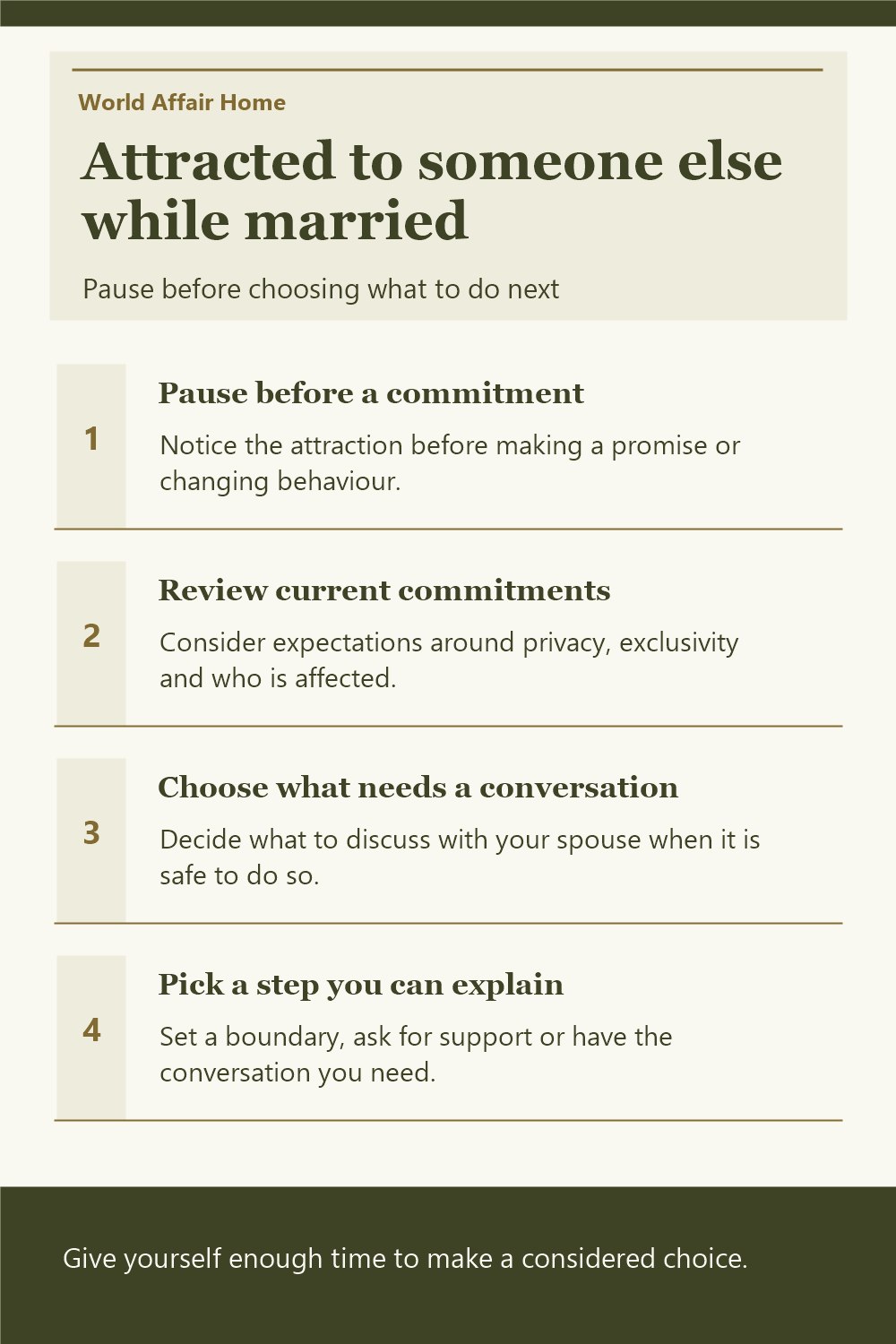
Read the infographic in text
Attracted to someone else while married
Pause before choosing what to do next
- Pause before a commitment Notice the attraction before making a promise or changing behaviour.
- Review current commitments Consider expectations around privacy, exclusivity and who is affected.
- Choose what needs a conversation Decide what to discuss with your spouse when it is safe to do so.
- Pick a step you can explain Set a boundary, ask for support or have the conversation you need.
Give yourself enough time to make a considered choice.