

Yes, a loving relationship can work without strong physical or sexual attraction when the people involved want the relationship they are choosing. It can also be a poor fit if one or both people feel that something important is missing.
The useful question is not whether you can make yourself want someone. Ask what you feel, what you want and whether you can discuss those needs honestly without either person being pressured to change.
On this page
Clarify what attraction means to you
Finding someone good-looking, wanting affection, feeling romantically drawn to them and wanting sexual contact can be different experiences. You might enjoy someone’s company without wanting to date, or feel romantic affection without wanting sex.
Some asexual people experience romantic attraction and form romantic relationships. Planned Parenthood explains the distinction between sexual orientation and romantic attraction. A lack of attraction to one person does not, by itself, determine your identity, and you do not need to choose a label to make a relationship decision.
Use your own words: “I enjoy being close to them,” “I want to keep this as friendship,” or, “I am interested, but I am still learning what I feel.”
Notice interest without turning dating into a test
If you are curious and comfortable, you can choose another low-pressure meeting, such as a walk or a visit to an exhibition. Pay attention to whether you look forward to seeing the person, feel at ease and want to know them better.
Attraction may change for some people and stay the same for others. There is no required number of dates and no promise that patience will create desire. You can stop exploring at any point.
Do not keep seeing someone because you think they have earned a relationship by being kind or because you fear appearing shallow. Respect includes allowing both people to seek the connection they actually want.
Avoid trying to argue yourself into desire
Someone’s good qualities can be real without producing attraction. A gratitude list, positive thinking or a comparison with worse partners does not create an obligation to date or become intimate.
Ask whether you are choosing freely or trying to avoid guilt, loneliness, family pressure or disappointing the other person. Those concerns deserve care, but they do not require you to promise feelings you do not have.
You also do not need a theory about genes, scent or gender to explain a personal preference. Treat the person in front of you with consideration while acknowledging your own response.

Talk about the relationship each of you wants
If you want to keep exploring, say so without promising a future change: “I like spending time with you, and I want to take this slowly. How does that feel to you?” The other person is free to decide that uncertainty does not work for them.
In an established relationship, discuss affection, intimacy and expectations in specific terms. What forms of closeness do you each enjoy? How important is sexual connection? What would feel comfortable, and what would not?
Different preferences do not automatically rule out a relationship, but agreement must work for everyone involved. Avoid an arrangement that depends on one person silently tolerating contact they do not want.
Keep physical contact freely chosen
Kissing or sex is not a test you have to pass to find out whether you are attracted to someone. You can decline, pause or change your mind. The other person has the same freedom.
RAINN’s consent guide describes agreement without pressure, manipulation or fear. Being married, dating for a long time or having agreed before does not remove the need for consent now.
If an unwanted change in desire, pain or another health concern is troubling you, you can ask a qualified clinician for support with that concern. The aim is to address what matters to you, rather than to make you want a particular person.
Leave room for friendship or an ending
You may decide that friendship fits better, provided both people genuinely want it. Friendship does not have to be a waiting room for romance, and someone who wanted a relationship may need distance.
If you want to end dating, be clear and kind: “I have enjoyed getting to know you, but I do not feel the connection I want for a relationship.” You can decline without criticizing their body or listing features they cannot change.
A relationship does not have to continue simply because it could work in theory. Your own needs and the other person’s wishes both belong in the decision.
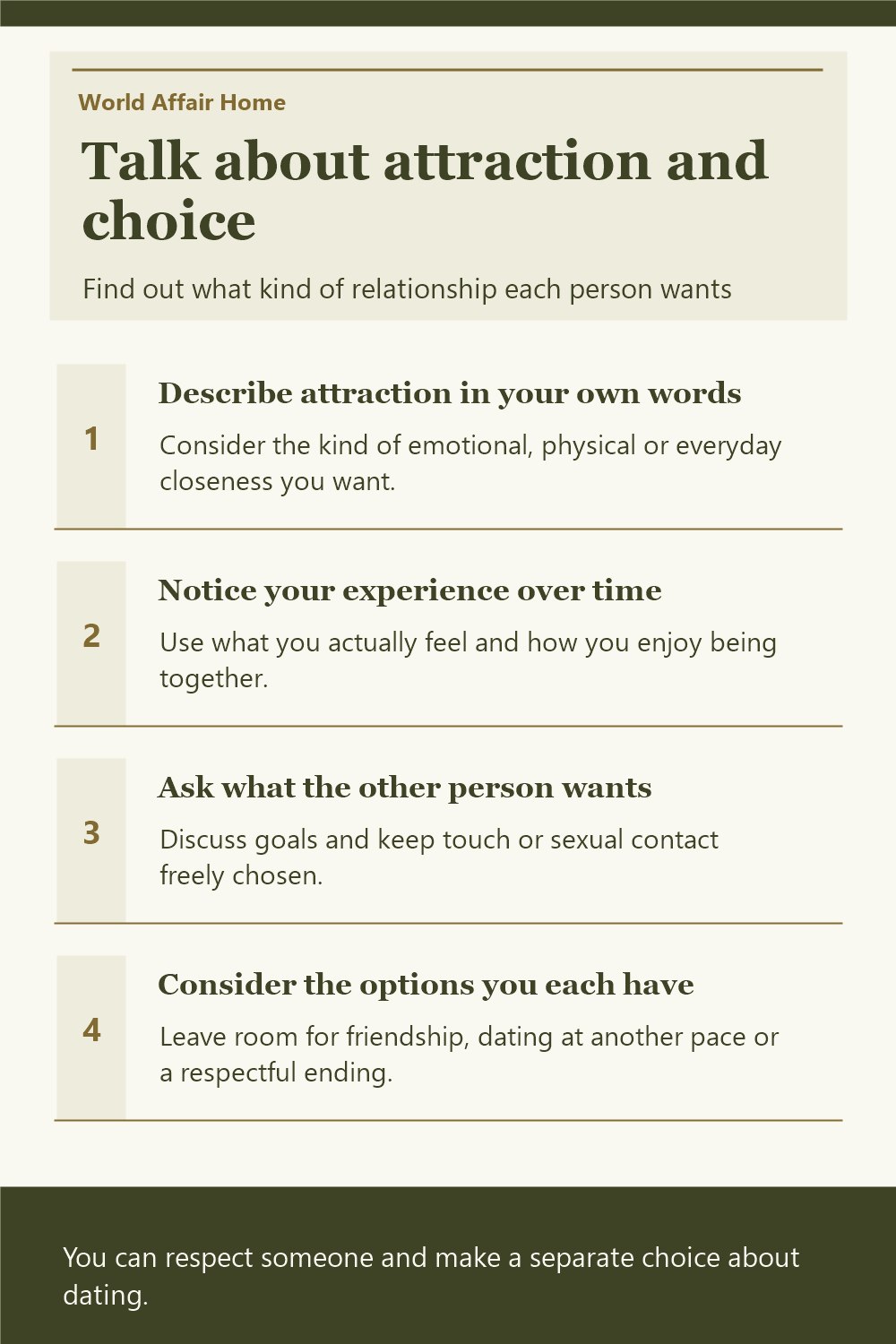
Read the infographic in text
Talk about attraction and choice
Find out what kind of relationship each person wants
- Describe attraction in your own words Consider the kind of emotional, physical or everyday closeness you want.
- Notice your experience over time Use what you actually feel and how you enjoy being together.
- Ask what the other person wants Discuss goals and keep touch or sexual contact freely chosen.
- Consider the options you each have Leave room for friendship, dating at another pace or a respectful ending.
You can respect someone and make a separate choice about dating.