

Thinking about getting back with an ex can bring affection, hope, hurt and uncertainty at the same time. If cheating was involved, you may also be deciding what trust and accountability would need to look like.
You can explore the possibility without agreeing to restart the relationship. Consider what has changed, whether both people want to talk and what practical support would give you more room to choose.
On this page
- Look for accountability and changes in behaviour
- Separate missing someone from wanting the relationship back
- Keep children’s needs in the practical plan
- Treat housing, money and support as real needs
- Check that both people can choose freely
- Discuss what a renewed relationship would involve
- Choose a pace and a time to review it
- Put individual safety ahead of repairing the relationship
Look for accountability and changes in behaviour
If an agreement was broken, ask whether the person who broke it can acknowledge their choices without blaming you. Problems in a relationship can be discussed separately from responsibility for cheating.
Listen for specific actions rather than a broad promise to be different. What has changed since the breakup? Which agreements do they understand differently now, and what are they prepared to do consistently?
An apology may matter without being enough for you to return. You can appreciate an effort and still decide that you do not want to resume the relationship. For more on the early decisions after betrayal, read After Discovering an Affair: What to Prioritize First.
Separate missing someone from wanting the relationship back
Loneliness, familiar routines and missing shared experiences can all matter. Having those feelings does not make you weak, and it does not settle the question of whether reconnecting would meet your needs.
Ask what you miss specifically: the person, companionship, a shared home, a particular routine or the future you imagined. Which needs could receive support independently of reconciliation?
You do not have to wait until you feel completely certain or content alone to make a decision. Aim to understand the pressures you are under so that they are part of the conversation rather than the only reason to return.
Keep children’s needs in the practical plan
If you share children, separate questions about parenting from questions about romance. Discuss routines, school or care arrangements, communication and the support each child may need.
Avoid asking children to choose sides, carry messages or keep adult secrets. Do not promise that getting back together will fix everything, or that separation will be easy for everyone.
For decisions about parenting arrangements or legal responsibilities, seek advice suited to your circumstances and location. Children’s needs deserve careful attention without making them responsible for whether the adults reconcile.
Treat housing, money and support as real needs
Limited money, housing or help can make a decision difficult. These are practical barriers, not a failure of self-respect. A friend’s sofa, a new tenancy or family support may not be available, affordable or safe.
List what you would need for each possible next step: a place to stay, transport, documents, access to your own money, care arrangements or qualified advice. Start by finding out which local services or trusted people can actually help and what their limits are.
Staying in the same home while working out practical arrangements does not have to mean promising a romantic restart. Where it is safe, clarify what each of you understands the arrangement to be.
Check that both people can choose freely
One person wanting to reunite is not enough. Ask whether the other person wants to explore it, and respect an answer of no, not now or uncertainty.
You might say, “I am willing to talk about what would be different. I am not ready to make promises.” Agree how and when to communicate without repeated messages, uninvited visits or pressure for an immediate answer.
Sex, gifts, an apology or help with expenses do not create an obligation to resume a relationship. Each person needs room to make their own choice.

Discuss what a renewed relationship would involve
Talk about the issues that led to the breakup in observable terms: communication, exclusivity, shared responsibilities, substance-related behaviour or different plans for the future. Avoid expecting that a reunion itself will solve them.
Agree on a few practical changes you both understand. For example, how will you raise a concern, manage time together and apart, or handle a disagreement?
Keep privacy and consent in the plan. Constant access to accounts, devices or location information is not a substitute for reliable behaviour and freely chosen agreements.
Choose a pace and a time to review it
If both of you want to try, you can begin with conversations or limited time together before making larger commitments. Discuss what “trying again” means rather than assuming you share the same expectations.
Choose a time to check how the arrangement feels. Are agreed actions happening? Can you speak openly? Are you choosing the relationship you have now, rather than relying entirely on the hope that it will become different?
You can slow down, change an agreement or decide to stop. Counselling may be an option when both people want it and can participate safely; it cannot guarantee reconciliation.
Put individual safety ahead of repairing the relationship
If there have been threats, stalking, coercion or violence, seek individual support from an abuse-support service before arranging a reunion or confrontation. You do not need to meet alone or explain a boundary in person.
If someone may monitor your devices, consider safer ways to look for help online. Use a safer device where possible; browsing privately cannot guarantee that activity is hidden.
A useful next step may be gathering information or asking for support, rather than giving a final answer today. Reconciliation is an option you may consider, not a duty you owe.
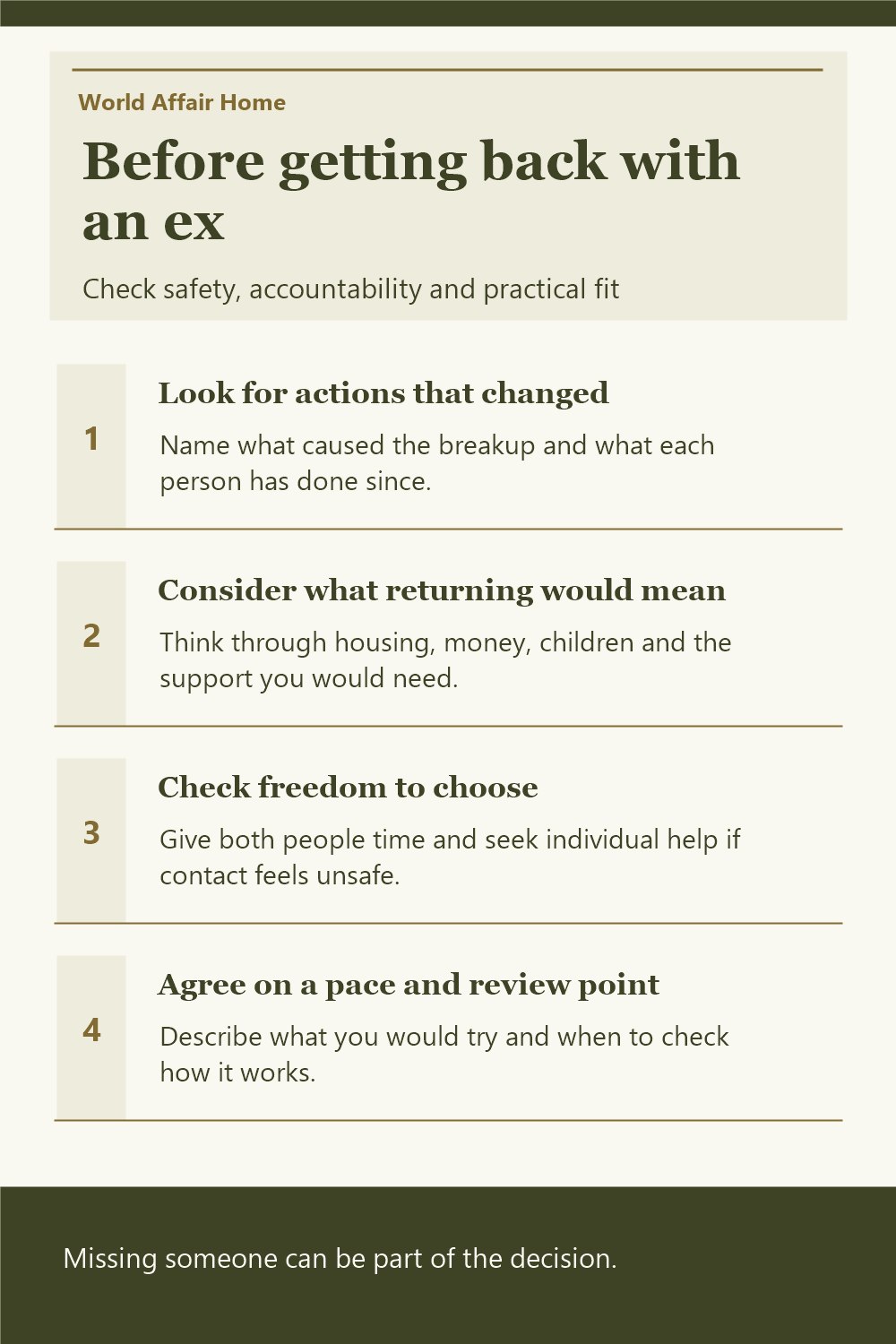
Read the infographic in text
Before getting back with an ex
Check safety, accountability and practical fit
- Look for actions that changed Name what caused the breakup and what each person has done since.
- Consider what returning would mean Think through housing, money, children and the support you would need.
- Check freedom to choose Give both people time and seek individual help if contact feels unsafe.
- Agree on a pace and review point Describe what you would try and when to check how it works.
Missing someone can be part of the decision.