

When a marriage is difficult, you may look for signs that it can be repaired. Affection, shared history and family commitments can matter, but no checklist can decide whether staying is the right choice or predict the outcome.
These nine questions focus on what is happening now and what both people can freely choose. If there are threats, coercion or violence, begin with individual safety support rather than a joint repair conversation.
On this page
- Do both people want to explore repair?
- Can you speak and disagree without fear?
- Can responsibility be specific rather than shared blame?
- Can you discuss needs and future plans honestly?
- What would a practical agreement look like?
- How will you keep family needs separate from pressure?
- Are affection and intimacy welcome to both people?
- How will you judge whether something has changed?
- What support fits the situation?
Do both people want to explore repair?
Ask whether each of you wants to discuss continuing the marriage. One person’s effort cannot establish the other person’s agreement.
You may value lifelong commitment, share children or remember good times. Those things can be part of your decision without requiring you to accept a particular outcome.
You can be willing to talk without promising to stay. Respect an answer of no or uncertainty rather than treating it as a reason for repeated pressure.
Can you speak and disagree without fear?
Consider whether each person can raise a concern, decline intimacy or ask for space without threats, humiliation, monitoring or retaliation.
The National Domestic Violence Hotline advises against couples counselling when abuse is present. A joint session may create risks rather than providing a safe place to address the problem.
If you are afraid of the response to a boundary, seek individual advice from a specialist abuse-support service. You do not have to confront the person or prove that the situation is serious enough before asking for help.
Can responsibility be specific rather than shared blame?
Name an action and its impact. “I hid that information” or “I insulted you” gives a clearer starting point than saying that both people simply need to be better.
If an agreement about fidelity was broken, responsibility for that choice belongs to the person who broke it. Other relationship difficulties can be discussed separately; they do not make a partner responsible for being deceived.
An apology can matter alongside a practical change. You can acknowledge an effort without treating it as a debt to forgive, resume intimacy or remain married.
Can you discuss needs and future plans honestly?
Talk about what each person wants from the relationship now. Include relevant questions about children, money, work, care, faith, where to live and the kind of partnership you want.
Look for answers you can act on rather than assuming that love will remove a major difference. A preference may change, but neither person should have to promise a different future simply to end a difficult conversation.
Decide which differences you can freely negotiate and which may mean that your plans do not fit.

What would a practical agreement look like?
Choose one or two changes that address an actual problem. For example, agree how to share a task, discuss spending or notify each other when a plan changes.
Make the action realistic and clear enough that you both understand it. “Be more caring” may need a more specific request, such as setting aside time to listen without interruptions.
Get qualified local advice before decisions with legal or financial consequences. Do not sign, transfer or cancel something merely to demonstrate commitment during an emotional conversation.
How will you keep family needs separate from pressure?
If you share children or other caring responsibilities, consider routines, practical support and how adult disagreements affect everyday arrangements.
Do not ask children to choose sides, carry messages or become the reason one adult must accept harm. A decision about parenting responsibilities is not identical to a decision about continuing romance.
Seek advice suited to your family and circumstances when needed. Avoid promising that staying together or separating will automatically make everything better for everyone.
Are affection and intimacy welcome to both people?
Wanting closeness can be meaningful, but it does not prove that the other problems are resolved. Not wanting sex does not by itself show that the marriage is beyond repair.
Discuss what kinds of affection or contact each person welcomes now. Previous intimacy, marriage or an apology does not remove the need for freely given agreement.
You can want different amounts or kinds of closeness. Address the difference with care, without making sex a test of loyalty or a required payment for another person’s effort.
How will you judge whether something has changed?
Good memories can remind you of what mattered in the relationship. Compare those memories with what is happening now rather than expecting a return to the past to settle the decision.
If both people want to try, agree on a manageable next step and a time to review it. Are the specific actions happening? Can you discuss their effect and adjust the plan?
You can revise a decision as you learn more. Choosing a trial period or continuing a conversation does not require ignoring new concerns or waiting indefinitely for an uncertain promise.
What support fits the situation?
Individual support may help you think through choices, practical barriers or distress. Ask a qualified provider about their approach, experience with your concerns, costs and confidentiality arrangements.
Where both people freely want to participate and can do so safely, couples counselling may be an option to discuss difficulties. If abuse or fear is present, prioritize specialist individual safety support instead.
Your next step might be a conversation, an appointment, gathering information or making a practical plan. Choose it from your present needs and circumstances, with room for both people’s decisions.
Read the infographic in text
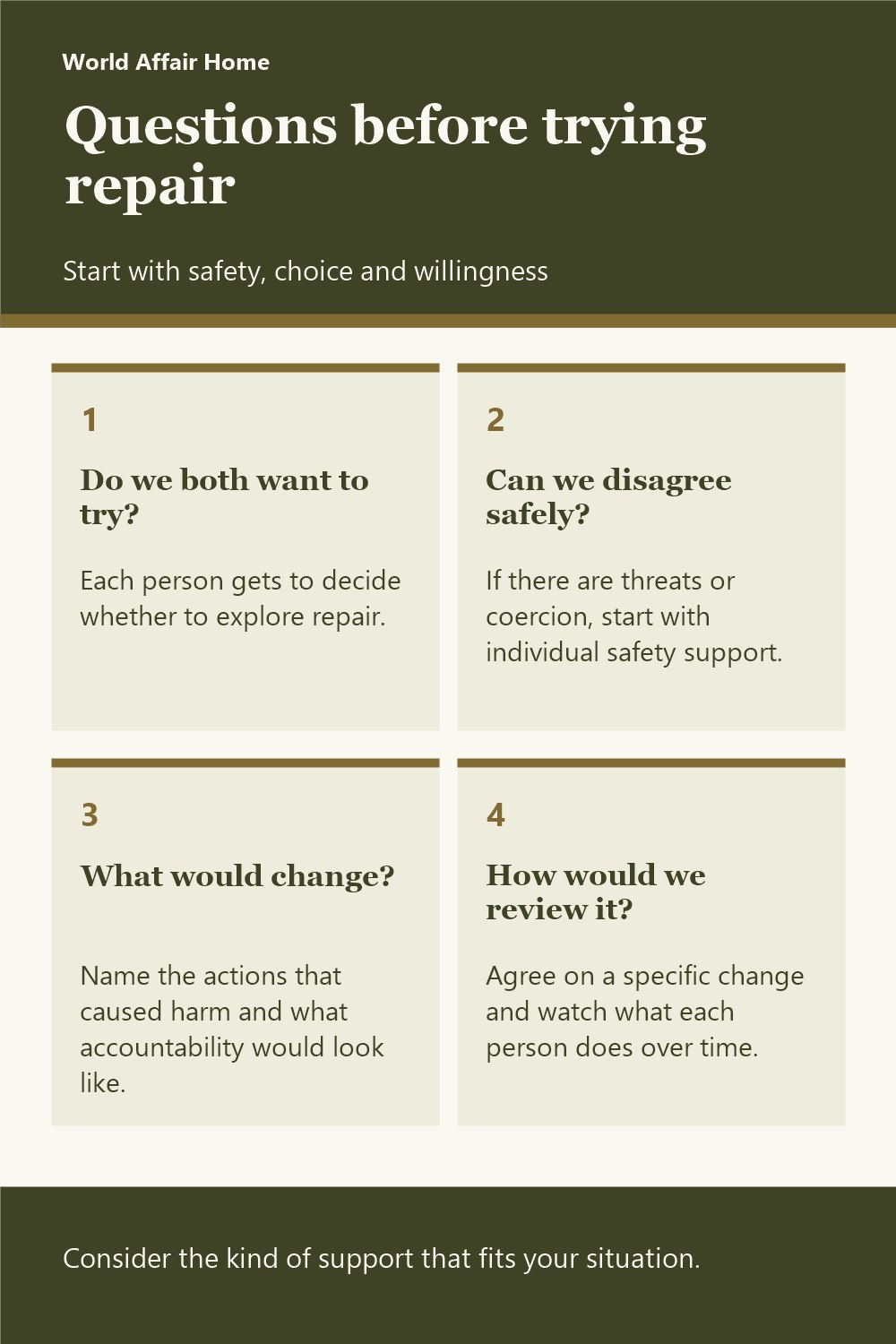
Questions before trying repair
- Do we both want to try? Each person gets to decide whether to explore repair.
- Can we disagree safely? If there are threats or coercion, start with individual safety support.
- What would change? Name the actions that caused harm and what accountability would look like.
- How would we review it? Agree on a specific change and watch what each person does over time.
Consider the kind of support that fits your situation.