

You may care about someone and still be unsure about the relationship. Excitement, attraction, empathy or shared interests can matter without answering every question about compatibility, commitment or safety.
Rather than deciding that uncertainty proves either true love or a bad relationship, identify what you need to understand. These questions can help you make a choice from your present situation.
On this page
- Name the uncertainty as a specific question
- Separate what happened from what you are assuming
- Ask directly about needs and intentions
- Distinguish caring from an obligation to stay
- Discuss differences that shape everyday life
- Notice whether you can choose freely
- Review what you know and choose a next step
Name the uncertainty as a specific question
Ask what you are unsure about: your feelings, the other person’s intentions, exclusivity, future plans, practical responsibilities or how a disagreement was handled.
Different questions need different responses. “Do we want the same kind of relationship?” may need a conversation, while “Do I enjoy spending time together?” may need room to notice your own experience.
Write one question you would like to answer first. You do not have to resolve every feeling before asking for clearer information.
Separate what happened from what you are assuming
Make two short lists: what you observed and what you think it means. For example, “They cancelled twice” is an observation; “They must be seeing someone else” is an interpretation that needs more information.
Ask about the actual pattern and its effect on you. You can say, “It is hard for me to make plans when they change late. What can we realistically agree on?”
Look at repeated behaviour in context. A thoughtful gesture can be welcome without cancelling a pattern that concerns you, and one awkward conversation does not supply a complete account of someone’s character.

Ask directly about needs and intentions
Share what matters to you, such as commitment, contact, privacy, time together or how to discuss a concern. Ask what the other person wants and can offer now.
Listen to an answer you dislike as well as one that reassures you. If someone does not want exclusivity, more patience or affection is not an agreement that they will eventually choose it.
You can decide whether the arrangement fits without insisting that either person’s preference is wrong. Being clear about a difference can be more useful than repeatedly trying to infer a hidden answer.
Distinguish caring from an obligation to stay
You may feel empathy for someone’s difficulties and also feel unsure about romance. Caring about their wellbeing does not require dating them, becoming their sole support or accepting treatment that hurts you.
Ask whether you enjoy the relationship being offered or feel that leaving would make you responsible for everything that happens next. Support can come from more than one person or service.
If someone threatens harm to pressure you into staying, seek appropriate crisis or specialist safety support. Do not make yourself the only person responsible for managing the threat or promise a relationship to keep someone safe.
Discuss differences that shape everyday life
You do not need identical interests or personalities to build a relationship. Consider whether differences can be discussed and whether important plans fit.
Talk about relevant subjects such as children, money, work, faith, where to live, care and relationship structure. Some preferences are flexible; others may involve needs neither person wants to change.
A shared hobby, strong sexual attraction or an exciting beginning does not answer those practical questions. You can enjoy those parts while taking time to learn more.
Notice whether you can choose freely
Consider what happens when you ask a question, decline contact, want time apart or disagree. Can the conversation continue without threats, humiliation, intimidation or pressure?
Intensity alone does not tell you whether a relationship is caring or safe. Look at how each person handles limits and takes responsibility for their actions.
Physical intimacy needs to be freely chosen each time. If alcohol or another circumstance makes it difficult to communicate or choose clearly, pause rather than using intimacy to settle a relationship question.
Review what you know and choose a next step
Ask whether you now have clearer information and what remains uncertain. You might need a specific conversation, a different pace, qualified support or time away from the relationship.
Choose a manageable next step rather than demanding complete certainty. If you agree to try a change, decide when to discuss how it is working and what each person will actually do.
If fear or control is part of the situation, seek individual safety support before a joint conversation. Otherwise, give your own needs and the other person’s stated choices room in the decision.
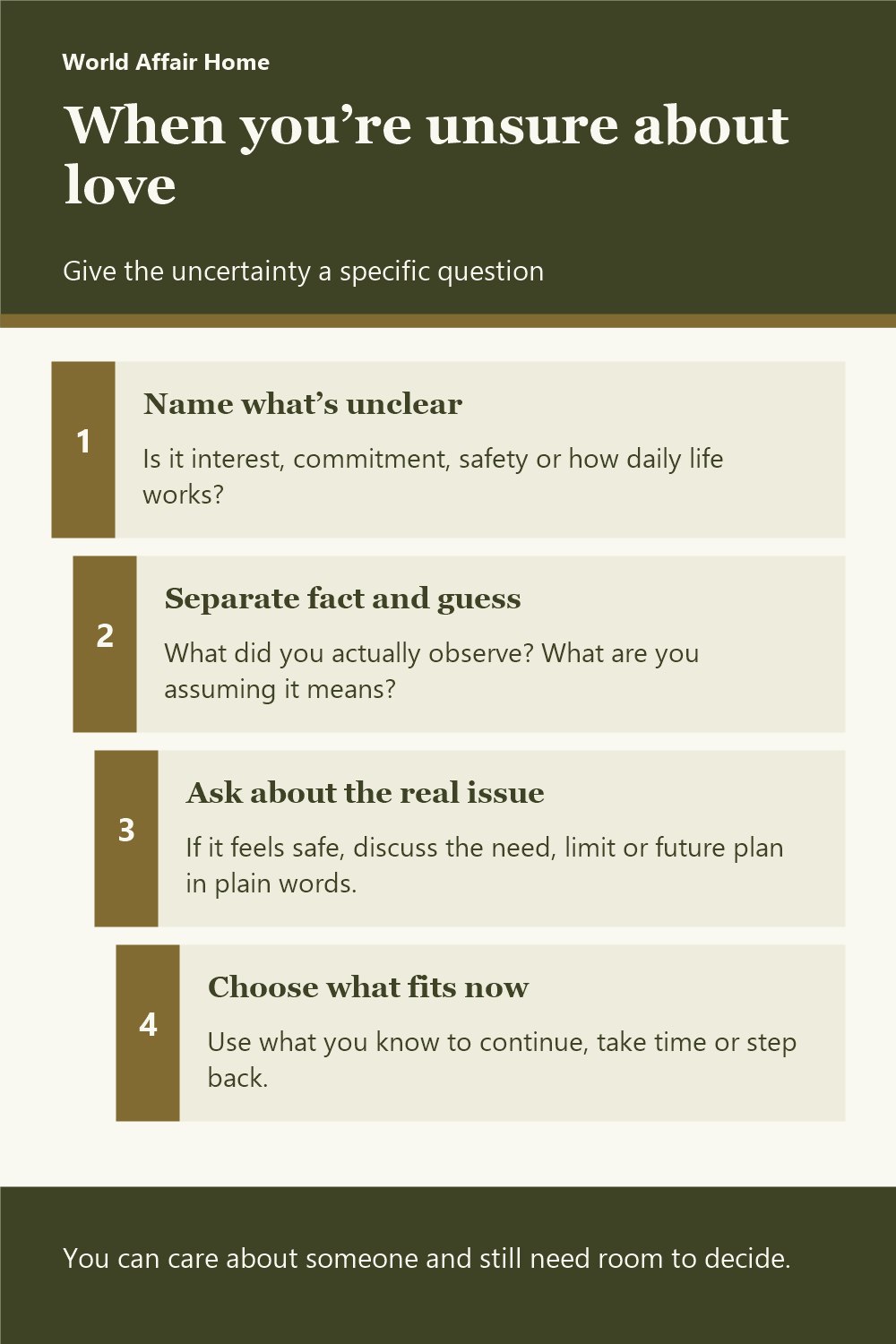
Read the infographic in text
When you’re unsure about love
- Name what’s unclear Is it interest, commitment, safety or how daily life works?
- Separate fact and guess What did you actually observe? What are you assuming it means?
- Ask about the real issue If it feels safe, discuss the need, limit or future plan in plain words.
- Choose what fits now Use what you know to continue, take time or step back.
You can care about someone and still need room to decide.