

Suspecting that a partner is cheating can leave you looking for an explanation in every message, changed plan or unfamiliar detail. A checklist cannot establish what someone has done. Many ordinary behaviours have several possible explanations, and accumulating ambiguous clues does not turn them into proof.
You can take concerns seriously while focusing on shared agreements, specific inconsistencies and your own choices. You do not need to become a detective or obtain a confession before deciding what kind of relationship you can continue.
On this page
Separate concern from certainty
Begin with what you directly know. “We agreed to be exclusive” and “You told me two different things about Friday” are clearer starting points than “You have been acting strangely.” Describe the inconsistency without claiming to know its cause.
You may not get a complete answer immediately. Consider what information affects your decisions, which questions you want to ask and whether it feels safe to raise them. You can take time to think or seek support.
Understand what common clues cannot tell you
A change in clothes or style, or a different manner or confidence, does not establish infidelity. A person can change their appearance for many reasons.
New hobbies, different food preferences and unfamiliar phrases may reflect ordinary interests or social contact. They do not identify a secret romantic partner.
Being busy, seeming distracted or changing a routine can affect your time together. Discuss the practical effect without assuming you know where their attention has gone.
Phone privacy, offering or declining to show messages, cleared browser history or a second device cannot independently prove honesty or deception. Access to someone’s accounts is not an infidelity test.
Changes in sex, emotional closeness or how often someone says “I love you” deserve a conversation when they matter to you. They do not reveal a cause on their own. Affection and sex remain voluntary.
A change in mood, a defensive response or a long explanation is not a reliable lie detector. Pay attention to whether you can discuss an issue respectfully, rather than decoding tone as proof.
Repeated criticism, unhappiness, unmet needs or jealous questioning may be relationship concerns in their own right. Cheating does not have to be established before you address harmful treatment.
Distance from a partner’s friends or family, or your friends disliking the relationship, is not direct knowledge of an affair. Ask what someone actually observed rather than adopting their conclusion.
Missing clothes, a changed shower time, an unfamiliar scent, a stray hair or a moved passenger seat cannot tell you what happened. Avoid turning household details into an ongoing search for guilt.
If you encounter a dating profile that appears to be your partner’s, ask about the specific issue and your exclusivity agreement. An old, copied or misidentified profile is different from confirmed current activity. Do not impersonate someone to test the person.
Questions about receipts or shared finances can be addressed through the financial arrangements you both agreed to. A private purchase does not automatically establish an affair.
Contradictory stories can reasonably prompt a question. Being called “paranoid” is not proof of guilt, but dismissive or insulting treatment still matters.
A gut feeling may alert you to discomfort; it cannot independently verify someone else’s private conduct. Intuition or a psychic reading may hold personal meaning without establishing whether a partner has cheated.

Prepare a clear conversation
Choose one concrete concern. Write down what was agreed, what you observed and what you need clarified. Keep the question separate from a prediction about the answer.
Consider the purpose: are you asking whether an agreement was broken, discussing a change in closeness or deciding whether to continue? You do not need to settle every concern in one discussion.
A trusted friend can listen and help you think through options. Avoid recruiting them to spy, question other people or spread an unverified accusation.
Think about practical support if the answer is difficult: someone to speak with afterward, time to consider your decision or help with responsibilities. You do not have to prepare an immediate exit as a test of self-respect.
If questions bring threats, monitoring or intimidation, the concern includes your safety. Unwanted Contact and Controlling Behaviour: Patterns and Support discusses those behaviours without diagnosing a partner.
If you feel afraid, do not arrange an ambush or confrontation to obtain an answer. A local abuse-support service can help you consider options suited to your circumstances.
Keep privacy and boundaries intact
Searching a partner’s car or belongings is not a sound substitute for discussing an agreement. Patterns that affect you can be described without secretly collecting their personal information.
Do not search private phone messages or install spyware. Location sharing should not be switched on secretly or obtained through pressure.
Avoid monitoring every social interaction or using fake accounts to test someone. Searching their rubbish also turns uncertainty into surveillance rather than a workable relationship agreement.
Do not install hidden cameras to watch a partner. Hiring an investigator is not a universal next step in relationship advice. If a legal matter requires information, obtain qualified local advice about your own situation.
Do not follow someone or turn up unexpectedly to catch them. If you are experiencing surveillance yourself, The Hotline’s stalking safety-planning guidance offers information and support. Consider whether you can safely seek help using the device available to you.
Choose a practical next step
You may agree on clearer boundaries, consider repair after a confirmed breach, seek individual support or decide that the relationship no longer works for you. You do not owe immediate forgiveness, and staying so far does not make another person’s actions your fault.
If trust has been broken, After Infidelity: Should You Consider Another Chance? offers questions about that choice. A clear agreement and observable follow-through are more useful than another collection of ambiguous clues.
Read the infographic in text
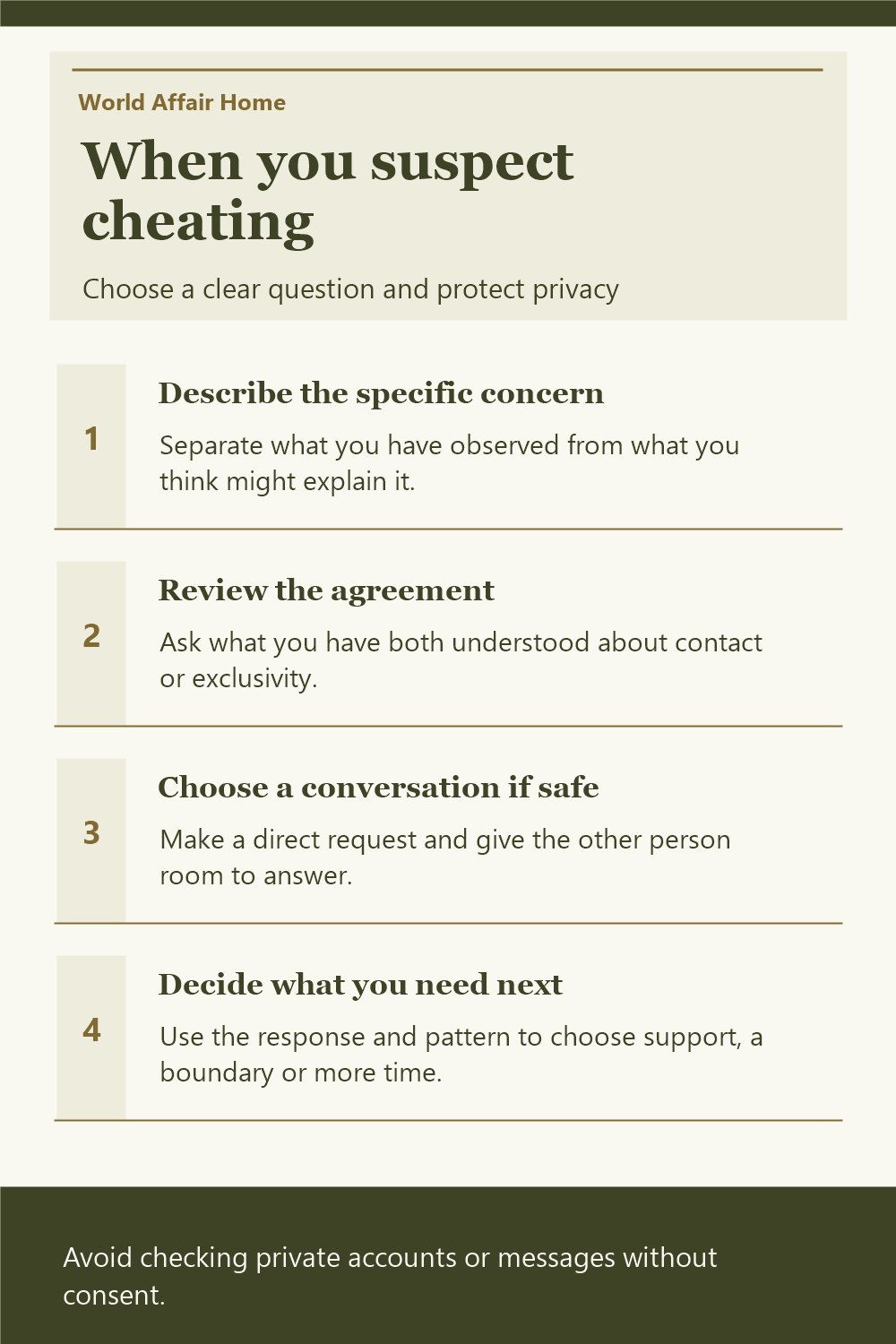
When you suspect cheating
Choose a clear question and protect privacy
- Describe the specific concern Separate what you have observed from what you think might explain it.
- Review the agreement Ask what you have both understood about contact or exclusivity.
- Choose a conversation if safe Make a direct request and give the other person room to answer.
- Decide what you need next Use the response and pattern to choose support, a boundary or more time.
Avoid checking private accounts or messages without consent.