

Breaking up and getting back together can leave you hopeful, tired, uncertain or several things at once. A reunion may feel meaningful without answering the questions that led to the separation.
Instead of assuming that returning proves destiny or that every repeated breakup must fail, look at what is happening now. Consider what each person wants, what has changed and what support would help you choose freely.
On this page
- Describe the pattern without turning it into a verdict
- Separate missing someone from agreeing to return
- Look for specific changes rather than a promise
- Clarify what the relationship is now
- Give practical responsibilities their own plan
- Choose contact boundaries that fit your situation
- Ask for support without accepting shame
- Leave room to try, pause or stop
Describe the pattern without turning it into a verdict
Write down a few recent turning points: what led to a breakup, how contact restarted and what was agreed afterward. Use events you can describe rather than a diagnosis of either person.
Did you separate over the same unmet agreement, different plans for the future or an argument about something else? Were the reasons ever discussed, or did affection and relief replace the conversation?
Becoming clear about a pattern can help you identify a next step. It does not require deciding who is entirely good or bad, and it does not make you responsible for another person’s harmful choices.
Separate missing someone from agreeing to return
You might miss the person, companionship, shared routines or the future you imagined. Those feelings deserve attention without automatically becoming a commitment to restart.
Ask what you would want from another attempt and what is actually available. Familiarity can matter, but a familiar arrangement may still not meet your present needs.
A warm message, apology, gift or intimate encounter does not settle whether you are together again. You can care about someone and still ask for time, distance or a different arrangement.

Look for specific changes rather than a promise
If you both want to consider a reunion, name a small number of issues in practical terms. For example: keeping plans, discussing exclusivity, sharing responsibilities or raising disagreements without insults.
Ask what each person is willing and able to do differently. “We will communicate better” becomes more useful when it includes how you will raise a concern, respond and revisit an agreement.
Change cannot be guaranteed, and one conversation does not establish a lasting pattern. You can notice real effort without committing to wait indefinitely or accepting blame for whether the other person follows through.
Clarify what the relationship is now
Discuss whether you are separated, exploring reconciliation, dating again or only handling shared practical matters. Avoid assuming that the same label means the same thing to both of you.
Ask about contact, exclusivity, physical intimacy and expectations around other relationships where relevant. Agreement to one kind of contact is not agreement to every other part.
You might say, “I am willing to talk about trying again, but I am not agreeing to resume the relationship today.” The other person can decline that arrangement, and you can decide what you will participate in.
Give practical responsibilities their own plan
Housing, money, children, work or caring for a pet can keep people connected after a breakup. Needing to discuss those responsibilities does not require a romantic reunion.
List the practical issues that need attention and what information you still need. Get qualified local advice before decisions with legal or financial consequences; an emotionally easier conversation is not always a sufficient basis for a commitment.
If children are involved, keep adult decisions with the adults. Avoid asking children to choose sides, carry messages or accept promises that a reunion will fix everything.
Choose contact boundaries that fit your situation
Where it is safe, discuss the channel, topics and timing of contact. A period without personal messages may help some people; others need a limited way to discuss shared responsibilities.
Be specific about your participation: “I will reply to messages about collecting belongings, but I am not ready for late-night personal conversations.” Do not use constant contact, account access or location checks as a test of commitment.
Respect a request for distance. If unwanted contact, threats or monitoring continue, consider specialist safety support rather than treating it as a romantic sign of persistence.
Ask for support without accepting shame
A trusted person can help you think through options, make a practical plan or notice something you have missed. Ask what they can offer and whether you want advice or simply someone to listen.
Friends may have limits on their time or feel unsure how to help. That does not mean you deserve abandonment or must make the choice they prefer to remain worthy of support.
If one person is unavailable, consider another safe source. A qualified counsellor may also help you explore your choices; they cannot guarantee that a reunion or separation will feel easy.
Leave room to try, pause or stop
If both people freely want to try again, agree on a manageable next step and a time to discuss how it is working. Look at actual behaviour and how the arrangement affects your everyday life.
You can also decide that the relationship being offered does not fit, even if there is affection or uncertainty. You do not have to return once more to prove that you gave it every possible chance.
If there are threats, coercion, stalking or violence, prioritize individual safety support before announcing a plan or arranging a joint conversation. Practical constraints are real; taking time to find support is not a failure of self-respect.
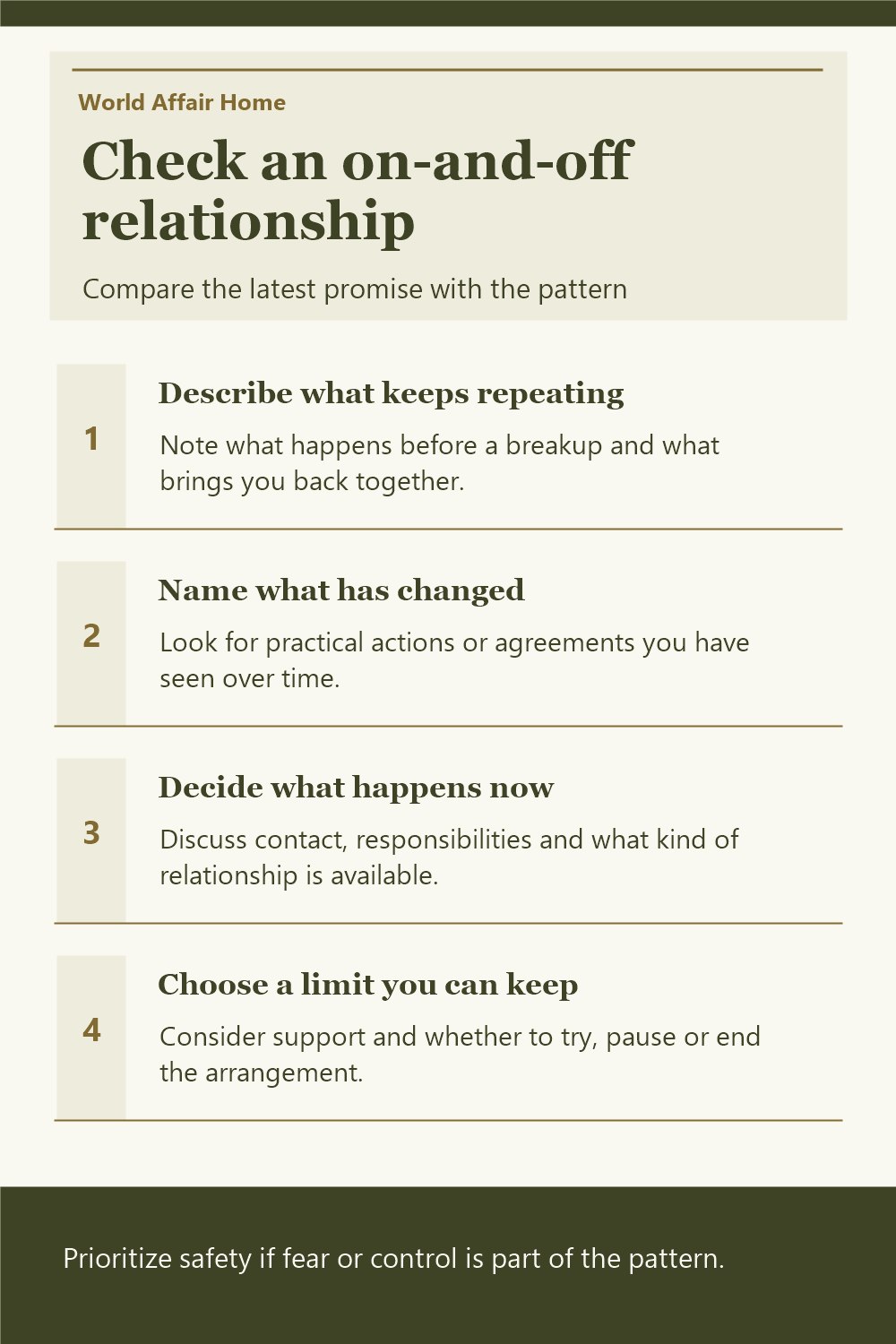
Read the infographic in text
Check an on-and-off relationship
Compare the latest promise with the pattern
- Describe what keeps repeating Note what happens before a breakup and what brings you back together.
- Name what has changed Look for practical actions or agreements you have seen over time.
- Decide what happens now Discuss contact, responsibilities and what kind of relationship is available.
- Choose a limit you can keep Consider support and whether to try, pause or end the arrangement.
Prioritize safety if fear or control is part of the pattern.