

When a relationship repeatedly leaves you hurt or unsettled, “enough” may be difficult to define. You might still care about the person, remember good times or face practical reasons that make change hard.
You do not need to prove that a relationship is bad enough before having limits or deciding to leave. Begin with what is happening, how it affects you and what you need for a next step you can freely choose.
On this page
- Compare promises with repeated actions
- Listen to outside perspectives without giving away your choice
- Separate responsibility from blame
- Review what staying or leaving would require
- State a boundary if it is safe to do so
- Make room for support and uncertainty
- Prioritize safety when there is fear or control
Compare promises with repeated actions
Choose a few concrete examples rather than trying to work out what someone secretly feels. What was agreed, what happened and how did they respond when you raised it?
A missed call or a changed plan can have many explanations. Repeatedly broken agreements deserve a conversation about reliability and what is realistically manageable. Context matters, including illness, disability, work or caring responsibilities; so does whether both people can discuss the impact.
Ask for something specific if you want to continue: “Please let me know when a plan changes.” Notice whether the agreement leads to a workable change over time, rather than relying only on another promise.
Listen to outside perspectives without giving away your choice
A trusted person may notice a pattern you have become used to. Ask what they have observed and what kind of help they can offer, rather than treating a label or prediction as proof.
You can listen to a concern without accepting every opinion. Friends and family do not always understand a situation, and some may pressure you to stay or leave for their own reasons.
Try saying, “I want you to listen while I think this through,” or, “Can you help me work out my housing options?” Seek support from someone who respects your choices and takes safety concerns seriously.
Separate responsibility from blame
Both people may have things to discuss after an ordinary disagreement. That does not make you responsible for another person’s decision to threaten, deceive, control or hurt you.
Your confidence, appearance or ability to explain yourself is not what makes you deserve respectful treatment. Being upset or having needs does not make mistreatment your fault.
Look at how each person takes responsibility: can they acknowledge an action, listen to its impact and make a realistic change? Repeatedly turning every concern into an attack on your character can make an honest conversation difficult.
Review what staying or leaving would require
Consider both emotional and practical needs. If you stay, what would need to change, and are both people willing to work on it? If you leave or reduce contact, what would you need to arrange?
Write down concrete issues such as housing, bills, work, children, other caring responsibilities and support. You do not have to solve them all at once. Start by finding reliable information about one issue.
Money or housing constraints can limit your options. These are real barriers, not evidence that you lack self-respect. Get qualified local advice for decisions with legal or financial consequences.
State a boundary if it is safe to do so
A boundary describes your limit and what you can do. For example: “I will pause a conversation if there are insults,” or, “I am not willing to lend more money.” It does not give you control over the other person’s response.
You can ask for a change and decide what you will do if the situation continues. Avoid promising a consequence you cannot or do not want to follow through on.
Love is respect’s boundary guide emphasizes being able to express needs and limits without fear. If doing that feels dangerous, seek individual safety support instead of relying on a better script.

Make room for support and uncertainty
You may feel affection, grief, relief or doubt while considering a change. None of those feelings settles the decision on its own. Forgiveness is also a personal choice; it does not require continuing the relationship.
A trusted person or qualified counsellor may help you think through your options. Ask about the support available and the provider’s approach. No one can guarantee that a relationship will improve or that a particular choice will feel easy.
You can take one practical step without announcing a final decision before you are ready.
Prioritize safety when there is fear or control
If there are threats, stalking, coercion or violence, consider a specialist abuse-support service before confronting the person or announcing plans. A joint conversation or couples counselling may not be a safe starting point.
If someone may be monitoring you, use a safer device where possible and read about internet safety when looking for support. Private browsing cannot guarantee that activity is hidden.
Your next step might be gathering information, speaking to an advocate or making a plan with a trusted person. You do not have to persuade the person causing harm that your needs are valid.
Read the infographic in text
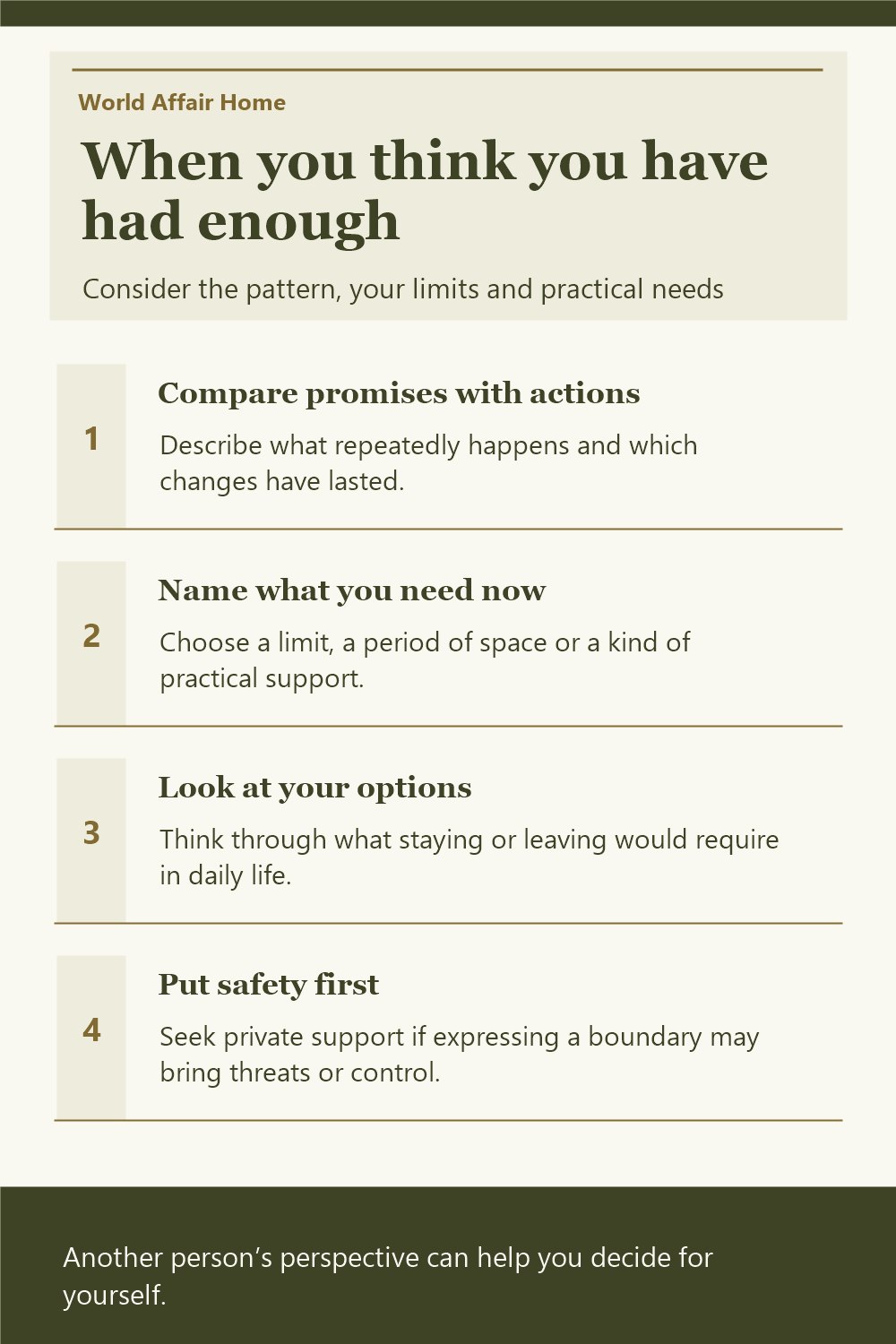
When you think you have had enough
Consider the pattern, your limits and practical needs
- Compare promises with actions Describe what repeatedly happens and which changes have lasted.
- Name what you need now Choose a limit, a period of space or a kind of practical support.
- Look at your options Think through what staying or leaving would require in daily life.
- Put safety first Seek private support if expressing a boundary may bring threats or control.
Another person’s perspective can help you decide for yourself.