

People use “unconditional love” to mean different things: lasting care, acceptance of a person’s humanity or a promise to stay together through anything. It helps to clarify which meaning you have in mind.
You can care about someone and still have conditions for a relationship, such as honesty, consent and respectful treatment. Feelings do not obligate you to offer unlimited contact, money, forgiveness or access to your body.
On this page
- Separate caring from agreeing to everything
- Make boundaries specific and within your control
- Discuss mutual effort without keeping a score
- Name deal breakers and repeated patterns
- Keep consent, privacy and independence in view
- Choose a response that fits the situation
- Include yourself in the care you offer
Separate caring from agreeing to everything
You do not have to approve of every choice a partner makes to care about them. You can disagree, decline a request or decide that a relationship is no longer right for you.
Try naming both parts: “I care about you, and I am not willing to lend more money,” or, “I want us to work this out, and I need conversations without insults.” A limit does not have to prove that your love is weak. It describes what you can freely and sustainably offer.

Make boundaries specific and within your control
A useful boundary explains your limit and, where needed, the action you can take. “If the conversation turns into shouting, I will pause it and return when we can speak calmly” is more workable than “You must never be angry.”
You can request a change, but you cannot control another person’s response. A boundary also does not justify controlling their friendships, movements or clothing. “I will not share my passwords” describes a choice about your own privacy; “You must give me all of yours” demands access to theirs.
Love is respect’s boundary guide emphasizes being able to express needs and limits without fear. If stating a limit feels dangerous, seek support rather than relying on a perfect script.
Discuss mutual effort without keeping a score
Fairness does not always mean splitting every task exactly in half. Work, disability, illness, caring responsibilities and available energy can change what each person can do.
Talk about the actual load: household work, planning, money, emotional support and time. Ask what feels manageable, which tasks matter most and whether outside help or a different arrangement is possible.
Notice whether concerns lead to a realistic conversation and shared adjustments. You do not have to earn affection by doing more, and a partner’s temporary need for support does not automatically mean they are taking advantage of you.
Name deal breakers and repeated patterns
A deal breaker is a limit on what you are willing to continue with. It might concern exclusivity, dishonesty, threats, substance-related behaviour or fundamentally different plans for the future. Be as clear as you can about what the issue means in practice.
Look at actions over time. An apology may matter, but consider whether the behaviour changes and whether you can raise the issue without being punished or blamed. You can decide that a limit has been reached without collecting proof for an argument.
You are also free to leave because the relationship no longer fits, even if neither person has committed a dramatic wrong. Different needs do not make either of you unworthy of care.
Keep consent, privacy and independence in view
A relationship does not grant automatic access to sex, messages, accounts or location information. Consent to intimacy needs to be freely given and can change. Gifts, commitment and previous intimacy do not create a debt.
Keep room for friendships, interests and time alone. When a partner wants more closeness than you do, discuss what each person wants rather than treating constant availability as the only sign of love.
If you are considering a shared account, device or household arrangement, talk about access and responsibilities before agreeing. Avoid making a permanent commitment just to end an argument.
Choose a response that fits the situation
For an ordinary disagreement, start with one clear request: “I want us to agree before inviting overnight guests.” Explain why it matters and listen to the response. If you agree on a change, choose a practical time to check how it is working.
You might decide to renegotiate an arrangement, reduce contact, get individual support or end the relationship. You do not have to keep repeating the same conversation to justify your decision.
If there are threats, coercion, stalking or violence, safety planning can be more useful than a direct confrontation. Contact a local abuse-support service from a safer device if possible. Responsibility for abusive behaviour belongs to the person choosing it.
Include yourself in the care you offer
Ask what you need to remain connected to your own life: rest, friendships, financial stability, privacy and the freedom to say no. A small starting point may be protecting one evening, declining one request or speaking with someone you trust.
You can feel grief, affection or uncertainty after setting a limit. Those feelings do not require you to undo it. Choose the next step based on your needs and circumstances, with support where useful.
Read the infographic in text
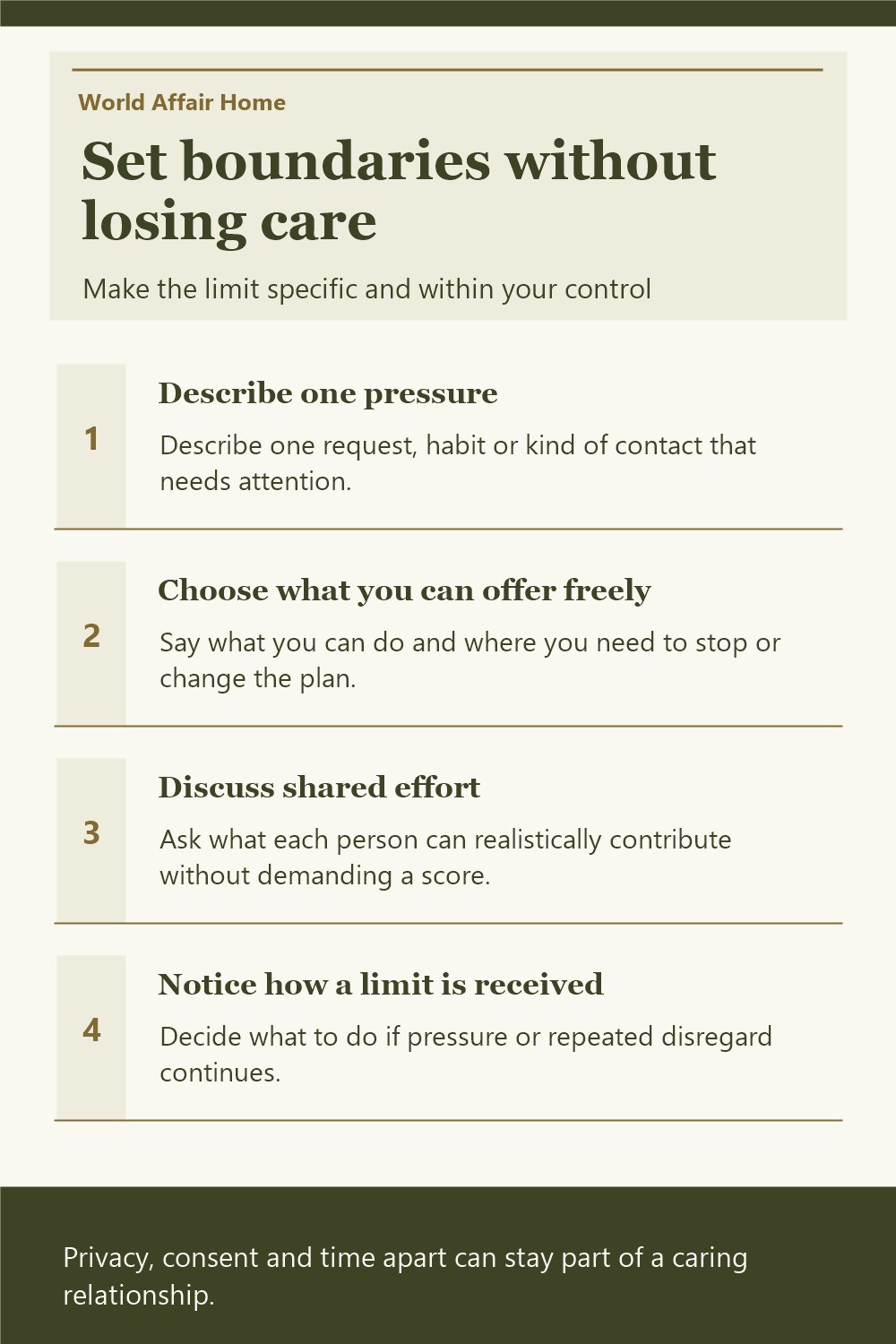
Set boundaries without losing care
Make the limit specific and within your control
- Describe one pressure Describe one request, habit or kind of contact that needs attention.
- Choose what you can offer freely Say what you can do and where you need to stop or change the plan.
- Discuss shared effort Ask what each person can realistically contribute without demanding a score.
- Notice how a limit is received Decide what to do if pressure or repeated disregard continues.
Privacy, consent and time apart can stay part of a caring relationship.