

There is no secret that guarantees a successful marriage. What feels workable depends on both people’s needs, choices and circumstances, including how you handle responsibilities, disagreements, time and closeness.
Use these seven areas to choose a conversation you actually need. The aim is an arrangement both people can freely accept, rather than making one person responsible for keeping the marriage together.
On this page
- Keep room for your individual lives
- Listen for the concern and clarify the request
- Make disagreement safe and workable
- Take responsibility for specific actions
- Choose time together that fits your actual life
- Discuss affection and intimacy without pressure
- Show care and review how the arrangement works
Keep room for your individual lives
Marriage does not require identical interests, constant contact or access to each other’s private conversations. You can share a life and still have friendships, interests and time that belong to you.
Discuss what time apart would look like in practice. Include caring responsibilities, money, transport and household tasks so that one person’s independence is not made possible by quietly leaving everything to the other.
A request might be: “I would like an evening for my class. How can we arrange our responsibilities so you also get time for something you want?” Revisit the arrangement when work or care changes.
Listen for the concern and clarify the request
Choose a time when you can both give the conversation some attention. Ask whether the other person wants listening, practical help or a discussion about a decision.
Reflect what you understood before defending your position: “You are frustrated that plans keep changing. Have I understood?” Then ask what change would help. Understanding a concern does not require agreeing with every interpretation of it.
If either person needs a break, discuss a realistic time to return to the subject. A pause can help a conversation continue; repeatedly postponing it without a next step leaves the original concern unanswered.
Make disagreement safe and workable
Some differences can coexist; others affect decisions you have to make together. Identify which kind you are discussing. A different film preference is not the same as incompatible plans about children or where to live.
Look for an agreement you both understand rather than treating “agree to disagree” as the end of a practical problem. Decide what you will do now, who is responsible and when to review it.
Threats, humiliation, intimidation or retaliation are reasons to seek individual safety support. Better communication by one partner cannot make another person’s abusive behaviour their responsibility.
Take responsibility for specific actions
Name your action and its effect rather than making a broad promise to be a better spouse. For example, acknowledge that you missed an agreed task, hid information or used an insult.
An apology can be followed by a practical repair: complete the task, correct the information or discuss how to handle a disagreement differently. Ask what is useful instead of deciding that a grand gesture settles the matter.
Relationship difficulties can be discussed without assigning shared blame for an individual’s choice to deceive or harm. Accountability does not create an obligation for the other person to forgive or stay.

Choose time together that fits your actual life
A date does not have to involve an expensive meal or an elaborate surprise. Ask what each of you would enjoy and what is realistic with your energy, budget, access needs and caring responsibilities.
A short walk, shared meal at home or uninterrupted conversation may fit better than a night out. Agree how to manage the practical work involved so that planning time together does not become another unequal task.
Notice whether the activity is welcome to both of you. Shared time can be valuable without being a test that proves how much someone cares.
Discuss affection and intimacy without pressure
There is no single amount or kind of sex that defines a successful marriage. Preferences, health, energy and comfort may differ or change; closeness needs to remain freely chosen.
Ask what kinds of affection each person welcomes now and what feels uncomfortable. Marriage, previous intimacy or doing something kind does not entitle anyone to sexual contact.
If a change concerns either of you, discuss it respectfully and consider qualified support suited to the concern. Do not pressure someone to try an activity or interpret a refusal as proof that the relationship has failed.
Show care and review how the arrangement works
Notice specific contributions and say what they mean to you. Appreciation can sit alongside a request for a fairer division of work; it should not be used to make an unequal arrangement acceptable.
Choose one small agreement to try, such as sharing a recurring task or setting aside time for a conversation. Check whether it happens, whether it helps and whether both people want to adjust it.
If you are considering a larger decision about the marriage, give it its own discussion and appropriate support. Affection, gratitude or effort does not require either person to promise a particular future.
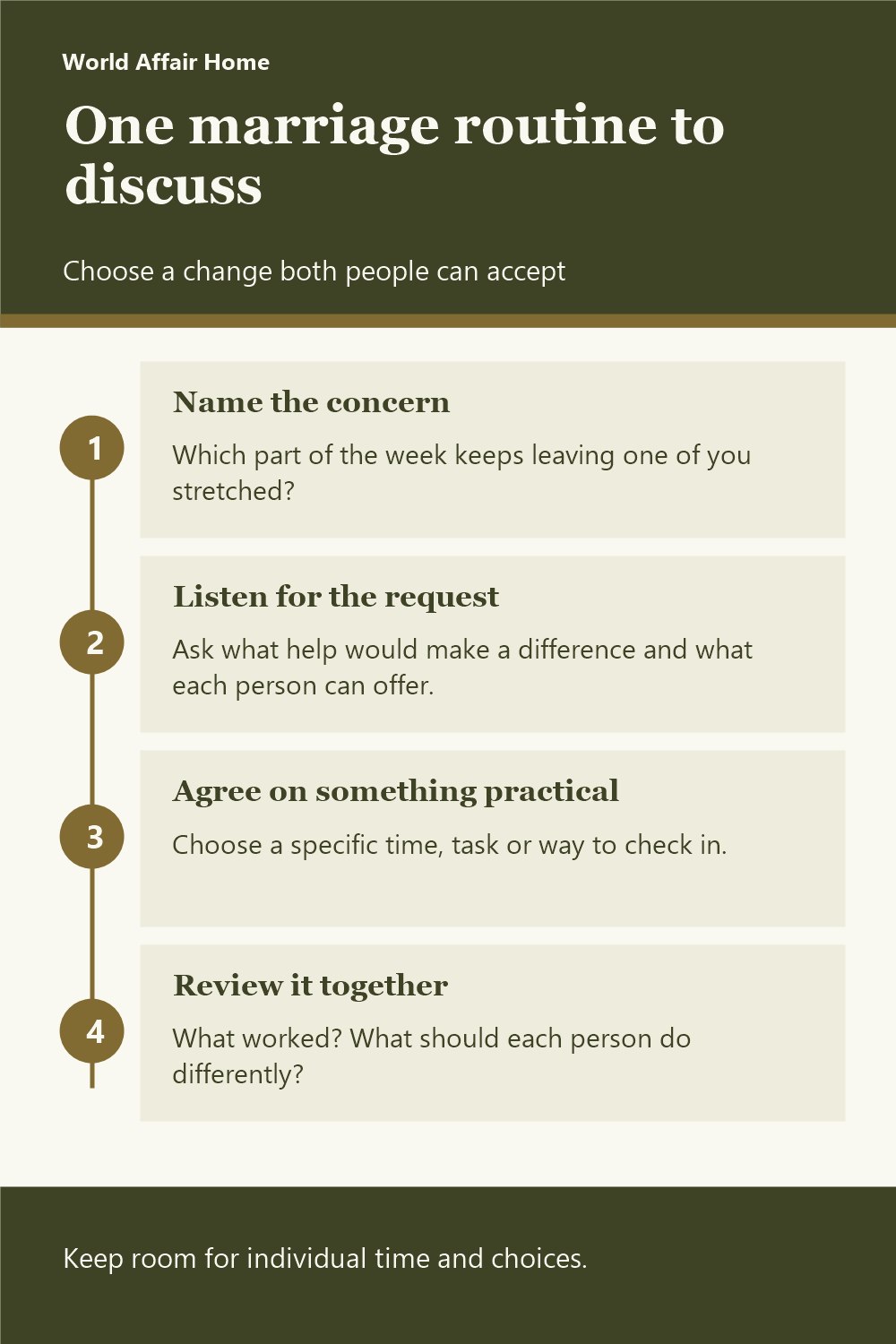
Read the infographic in text
One marriage routine to discuss
- Name the concern Which part of the week keeps leaving one of you stretched?
- Listen for the request Ask what help would make a difference and what each person can offer.
- Agree on something practical Choose a specific time, task or way to check in.
- Review it together What worked? What should each person do differently?
Keep room for individual time and choices.