

“Will I ever find love?” can become a painful question after disappointments, a breakup or a long period without the relationship you want. Advice to be more positive or simply stop looking may leave you feeling blamed rather than supported.
No article can promise when or whether you will meet a particular partner. You can still take your wish for connection seriously and make choices that support the life you have now.
On this page
- Leave room for uncertainty without making it a verdict
- Choose the kind of connection you actually want
- Look for compatibility rather than perfection
- Meet people in ways that fit your resources
- Keep dates freely chosen and manageable
- Ask for support without accepting a label
- Care for loneliness without blaming yourself
- Review your choices and allow a pause
Leave room for uncertainty without making it a verdict
Being single now does not provide a complete forecast of your future. It also does not tell you that you are unlovable, behind everyone else or failing a test.
You can want a relationship at any adult age without having to prove that you are young enough, confident enough or unusually accomplished. Your wish matters without a promise of a perfect match.
Try a more specific question: “What would help me feel more connected this month?” It may be easier to act on than trying to settle the rest of your life today.
Choose the kind of connection you actually want
Ask what you are hoping for: companionship, romance, affection, shared everyday life, sex, marriage or something else. These wishes can overlap without being identical.
You may want a committed partner, prefer a different arrangement or be unsure about dating at all. Other people’s expectations do not have to supply the answer.
Keep friendships, family or community connections in the picture too. They do not erase a wish for romance, but romance does not have to carry every need for support or belonging.
Look for compatibility rather than perfection
Choose a few qualities or agreements that matter in everyday life, such as kindness, reliability, relationship intentions, respect for boundaries or plans about children where relevant.
Separate those needs from an imagined person who must share every preference. You can be open to surprise without ignoring something important to you.
Pay attention to how you feel able to participate: can you ask questions, disagree or say no? An intense first impression does not replace learning how a person behaves over time.

Meet people in ways that fit your resources
Consider an activity, group, introduction or dating service that fits your energy, access needs, budget and interests. A short local event or online conversation may be more manageable than a busy dating schedule.
Some barriers are outside your personal control, including inaccessible venues, limited local options, caring responsibilities or discrimination. You do not have to turn every difficulty into a demand to try harder.
Choose a small next step if you want one, such as asking about access arrangements or accepting an introduction you are interested in. Participation creates an opportunity to meet someone, not a guaranteed result.
Keep dates freely chosen and manageable
You can ask what someone wants before investing more time, and you can decline a date that does not interest you. There is no requirement to say yes so you appear open-minded.
For an early meeting, choose a place and plan you are comfortable with, consider your own travel and keep the first arrangement manageable. You do not owe someone private details or a visit to your home.
Discuss pace, contact and exclusivity rather than assuming them. If an arrangement does not fit, you can step back without needing to make the other person wrong for wanting something different.
Ask for support without accepting a label
You can tell a trusted person, “I would like company,” or, “I am open to an introduction, but please ask me first.” Be clear if you want listening rather than advice.
Wanting support does not make you desperate. You do not have to accept surprise dates, repeated questions about your status or pressure to reconcile with an ex.
Other people have limits on what they can offer. If one person is unavailable, consider another safe source of connection rather than treating the response as proof that you should not ask.
Care for loneliness without blaming yourself
Try naming the part of the day or situation that feels hardest. You might need company during an evening, a routine after a breakup or support with a practical task.
A regular call, familiar activity or small plan may help with that particular need, even while you still want a partner. You do not have to pretend that friendship makes every disappointment disappear.
If distress or loneliness is making daily life difficult, ask a qualified healthcare professional or counsellor about support. Needing help is not evidence that you must fix yourself before deserving care.
Review your choices and allow a pause
Notice what your current approach gives you and what it costs in time, money or energy. You can change a profile, try a different setting, reduce your activity or take a break.
A pause does not have to be a permanent decision about love. Equally, you do not owe anyone ongoing dating effort just because they believe you should be looking.
Choose a next step that fits what you want now. Your life can include uncertainty and a wish for partnership alongside interests, relationships and responsibilities that matter today.
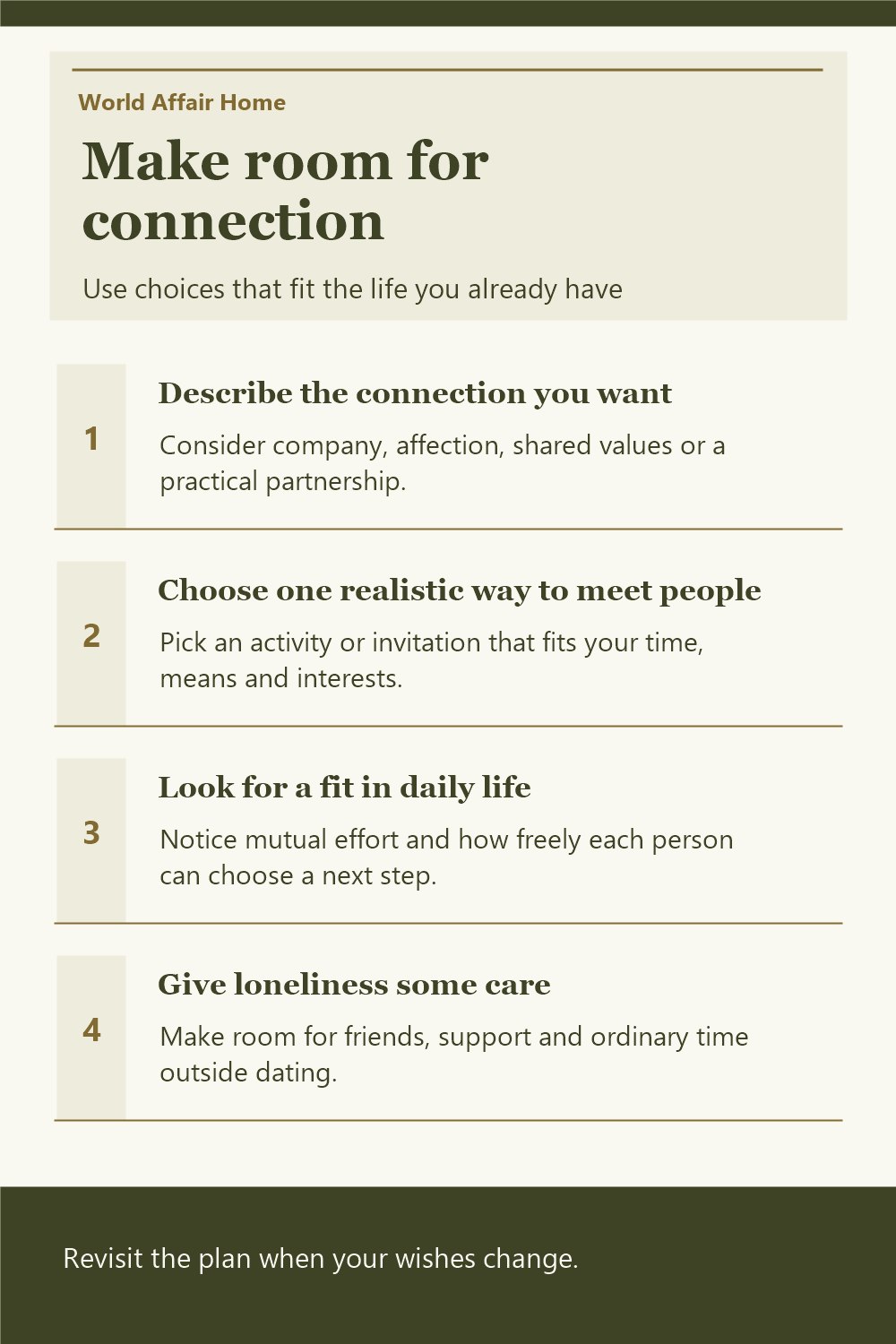
Read the infographic in text
Make room for connection
Use choices that fit the life you already have
- Describe the connection you want Consider company, affection, shared values or a practical partnership.
- Choose one realistic way to meet people Pick an activity or invitation that fits your time, means and interests.
- Look for a fit in daily life Notice mutual effort and how freely each person can choose a next step.
- Give loneliness some care Make room for friends, support and ordinary time outside dating.
Revisit the plan when your wishes change.