

Dating your best friend can begin with a kind of familiarity that feels reassuring: shared humour, interests and a sense of how you spend time together. Those things can be a good starting point when you both want to explore romance.
Friendship does not automatically establish attraction or compatibility, and it does not oblige either person to try a relationship. Before changing the connection, make room to ask clearly, hear the answer and decide what works for both of you.
On this page
- Ask whether you both want a date
- Choose what to share with family and friends
- Acknowledge that the friendship may change
- Respect the privacy of past relationships
- Check romantic fit alongside shared interests
- Discuss everyday habits without excusing harm
- Keep room for no and for changing your mind
- Check in after the date and choose the next step
1. Ask whether you both want a date
Being close friends does not make an ordinary outing a first date. If you are interested, name the possibility without assuming that shared time or affection already means romance. Choose a private moment with room for an honest answer.
You could say, “I have started wondering whether we might enjoy a date. Would you be interested in trying that, or do you want to keep our friendship as it is?” Ask once, then listen. If the answer is no, do not recruit mutual friends to change it.
If you both want to try, agree on a manageable plan: a walk, a meal or another activity you enjoy. Decide what makes this a date and what you would like to leave undecided.
2. Choose what to share with family and friends
Knowing each other’s families may make introductions more familiar. It does not mean relatives have already approved a relationship or should have a vote in whether you start one. Each person can choose how much to share and when.
Before telling a group, ask: “Are you comfortable with people knowing we are going on a date?” Consider practical details if you share a home, a workplace or a close circle of friends. Keep private conversations private, and avoid asking others to take sides if either person changes their mind.
3. Acknowledge that the friendship may change
It makes sense to value a friendship and worry about losing it. That concern cannot guarantee a successful romance, and it should not become a reason either person has to keep dating.
Talk about what you would want if the date felt friendly rather than romantic. You may hope to stay close, but neither person can promise that feelings and contact will remain exactly the same. Some space may be helpful; discuss what that means instead of disappearing or expecting immediate reassurance.
Trying a date is one choice. Keeping a friendship without pursuing romance is also a worthwhile outcome.
4. Respect the privacy of past relationships
You may know something about each other’s previous partners. That does not mean you know everything relevant to a new relationship, or that either person owes a complete account of private experiences.
Ask about what affects your choices now: whether you are available to date, what kind of relationship you want and any current commitments. Leave room to say, “I am not ready to discuss that detail.” Information shared in confidence during the friendship should not become ammunition in a disagreement.

5. Check romantic fit alongside shared interests
Liking the same music or enjoying long conversations can give you things to share. It cannot tell you whether you want the same relationship, feel romantic interest or handle important differences well.
Consider a few practical questions together: Do you want exclusivity? How much time can you offer? Do you have different plans about where to live or whether to have children? You do not need to settle your whole future before a first date, but an important difference deserves a conversation.
If attraction is absent, you do not have to persuade yourself into it by making a list of someone’s good qualities. Appreciation and friendship have value without becoming romance.
6. Discuss everyday habits without excusing harm
Familiarity may mean you already know some of each other’s routines. Dating can still bring new questions about time together, tidiness, money, social plans or personal space. Ask instead of assuming that a friend will accept everything because they know you well.
For example: “I like spending the evening together, but I need quiet time before sleep.” A useful response leaves room to work out a practical arrangement. Repeated insults, pressure or disregard for a stated limit are different from an irritating everyday habit; a long friendship does not make those behaviours acceptable.
7. Keep room for no and for changing your mind
A history of helping each other does not create a debt of romance, affection or sex. Neither person needs to prove gratitude by agreeing to a date. During dating, ask about what is welcome instead of treating familiar touch as permission for something different.
The love is respect guide to boundaries offers questions about comfort, privacy and how you want to be treated. Use those questions to put your own preferences into words, including when they change.
You can be disappointed by an answer and still respect it. If you need less contact to manage your feelings, explain that choice without using withdrawal as a threat to obtain agreement.
8. Check in after the date and choose the next step
Afterwards, talk about the experience rather than guessing what it meant. “I enjoyed that as a date and would like another. How did it feel for you?” gives both people a chance to answer.
If you continue dating, keep discussing plans, affection and time apart. Comfort with casual clothes or quiet evenings can be lovely when both people enjoy it; there is no requirement to perform a particular appearance or become constantly available.
Friendship can offer familiarity, humour and care as you explore a relationship. What matters next is whether you both want that change and can make choices freely as you get to know each other in a different way.
Read the infographic in text
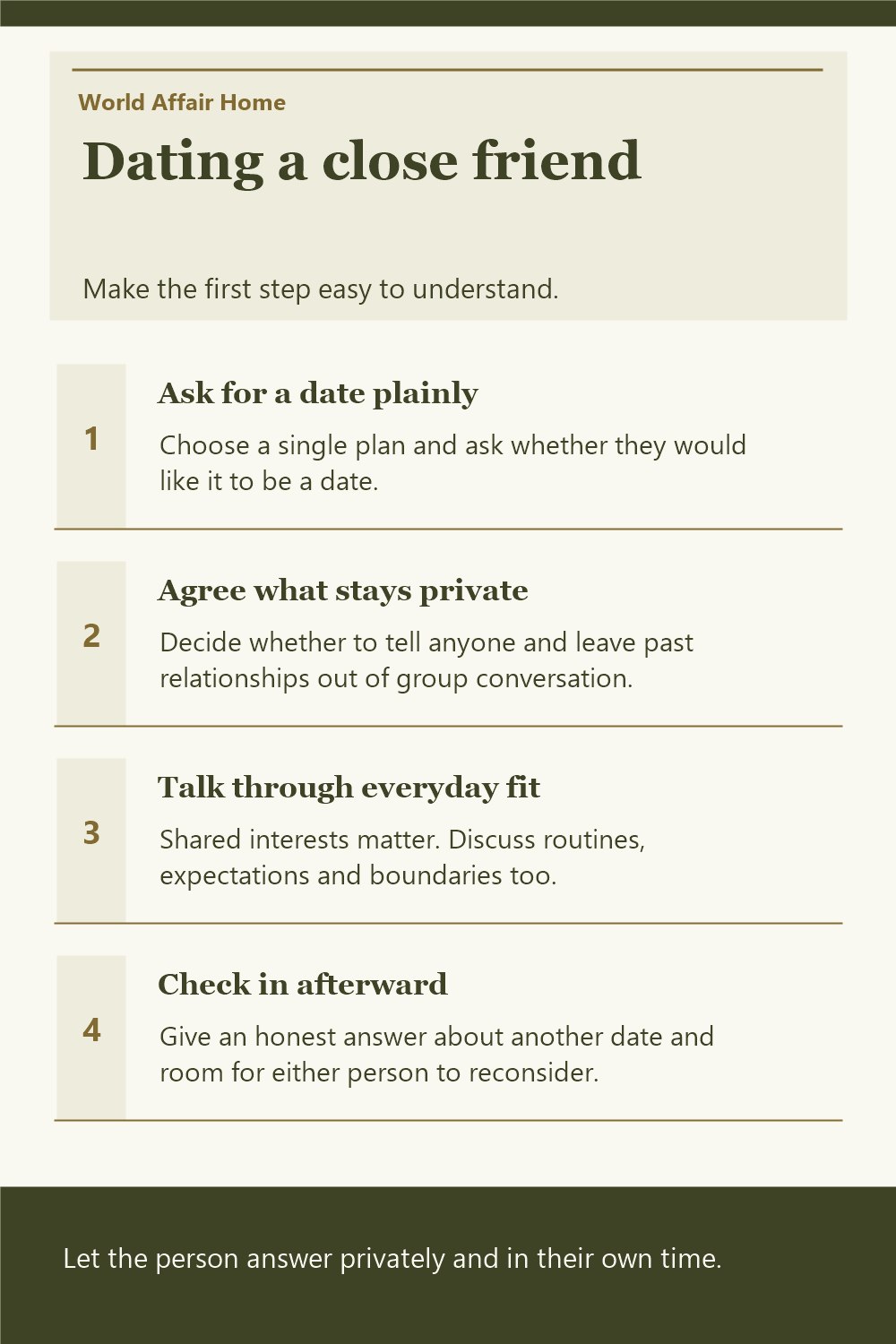
Dating a close friend
Make the first step easy to understand.
- Ask for a date plainly Choose a single plan and ask whether they would like it to be a date.
- Agree what stays private Decide whether to tell anyone and leave past relationships out of group conversation.
- Talk through everyday fit Shared interests matter. Discuss routines, expectations and boundaries too.
- Check in afterward Give an honest answer about another date and room for either person to reconsider.
Let the person answer privately and in their own time.