

Wanting to be loved is an ordinary human wish. It can hurt when affection is not returned, when someone becomes distant or when you feel you must keep proving why they should stay.
You do not have to earn basic respect through your appearance, confidence or usefulness. At the same time, each person can choose whether they want a romantic relationship. Keeping both ideas in view can help you respond without making rejection a verdict on your value.
On this page
- Separate your worth from one person’s response
- Keep care and mutual choice together
- Ask directly about the thing that matters
- Use fair self-talk rather than forced praise
- Keep preferences while allowing room to grow
- Build support that does not depend on dating
- Notice pressure, humiliation or control
- Choose one next step you can manage
Separate your worth from one person’s response
A person may not want the same relationship, may be unavailable or may not feel the connection you hoped for. You may never receive a complete explanation. None of those possibilities supplies a measure of your worth.
Try naming the event precisely: “They do not want to keep dating,” rather than, “Nobody could love me.” The first statement may still be painful, but it leaves room for the rest of your life and the people who know you.
You do not have to turn the other person into someone worthless to treat yourself fairly. You can acknowledge a disappointment and decide how much contact is manageable.
Keep care and mutual choice together
You deserve to be treated with dignity; that does not mean a particular person owes you attraction, commitment, sex or another chance. Their no matters, just as yours does.
If you have asked about a relationship and received a clear refusal, stop trying to persuade them. If their answer is uncertain, ask what is actually being offered and consider whether it works for you.
You can step away from an arrangement that leaves you waiting for a different answer. Choosing distance can be a way to meet your needs without punishing someone for having different ones.
Ask directly about the thing that matters
You do not have to pretend that contact, reliability or commitment is unimportant to appear easygoing. A clear request gives you more useful information than guessing what a delay or short message means.
For example: “I enjoy seeing you and would like to make plans a few days ahead. Is that something you want too?” Ask about a pattern or agreement rather than demanding access to private messages or constant reassurance.
Listen to the answer and notice what happens afterward. If the arrangement does not fit, that is information about compatibility, not proof that you asked badly or should need less.

Use fair self-talk rather than forced praise
You do not have to believe a sweeping positive statement for it to be helpful to question a harsh one. Make the claim specific enough to examine.
Instead of “I ruin every relationship,” try, “I regret interrupting that conversation. I can apologize and practise listening.” Taking responsibility for a particular action does not require attacking your whole character.
Likewise, another person’s insults are not a reliable assessment you must accept. Pause before treating a painful comment as a fact about who you are.
Keep preferences while allowing room to grow
Think about what matters in your everyday life: friendships, interests, faith or personal values, work, rest and the kind of partnership you want. You do not need an impressive list or a fully settled identity.
A relationship can involve compromise and change without requiring you to give up every preference. Ask whether a change is freely chosen, realistic and something you can discuss if it stops working.
You might enjoy dressing up for a date or trying someone else’s hobby. That can be a choice you welcome, rather than a rule that you must look or behave a certain way to keep affection.
Build support that does not depend on dating
Look for a manageable source of connection outside the romantic question: a friend, a relative you trust, an accessible group or an activity you enjoy. Availability and resources differ, so start with what is possible.
Ask for something specific, such as a short call or company while you handle a practical task. You can say whether you want listening, advice or a break from talking about dating.
You do not have to become completely content alone before seeking a relationship. Other sources of support can still matter while you want one.
Notice pressure, humiliation or control
Affection does not make threats, coercion, stalking or repeated humiliation something you must tolerate. Improving your self-esteem is not your responsibility for preventing another person’s harmful behaviour.
If you fear a response to a limit or a breakup, consider individual support from a specialist abuse-support service before a confrontation. You do not have to meet alone or explain until someone agrees.
If devices may be monitored, read the National Domestic Violence Hotline’s internet-safety guidance and use a safer device where possible. Private browsing cannot guarantee that activity is hidden.
Choose one next step you can manage
Choose something that supports you now: ask a direct question, mute an upsetting update, contact someone trustworthy or make time for an interest you have missed. You do not have to turn disappointment into immediate motivation.
If distress is making daily life difficult, ask a qualified healthcare professional or counsellor about available support. You can need help and still have agency.
Your next relationship is not guaranteed by a confidence exercise. Treating yourself fairly is worthwhile because your needs matter today.
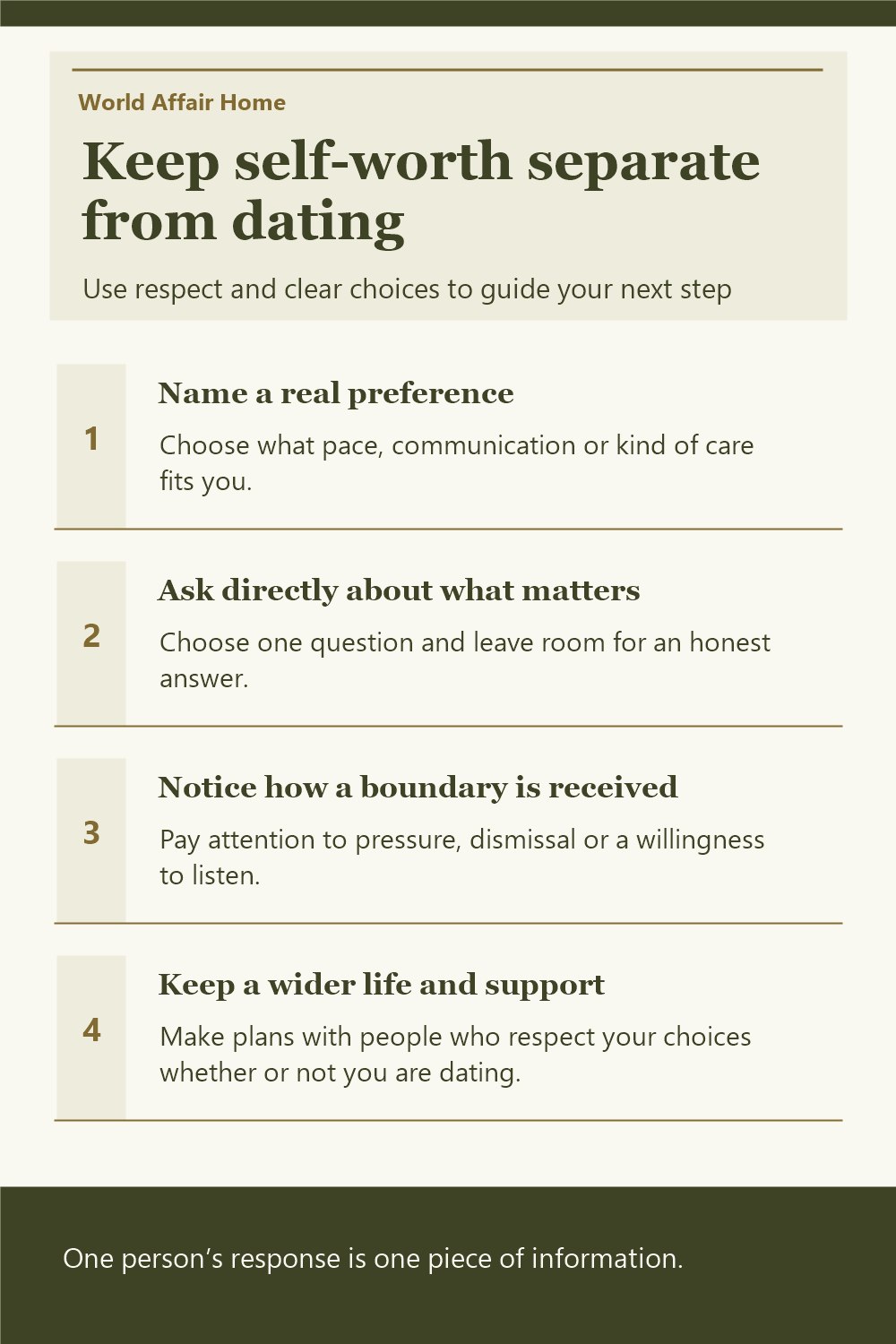
Read the infographic in text
Keep self-worth separate from dating
Use respect and clear choices to guide your next step
- Name a real preference Choose what pace, communication or kind of care fits you.
- Ask directly about what matters Choose one question and leave room for an honest answer.
- Notice how a boundary is received Pay attention to pressure, dismissal or a willingness to listen.
- Keep a wider life and support Make plans with people who respect your choices whether or not you are dating.
One person’s response is one piece of information.